



Cats have a reputation for being independent and low-maintenance. But when it comes to their health, they need just as much attention as any other family pet, and that includes regular vaccination.
Australia is home to around 5.8 million cats, with 34% of households having at least one. Yet only 66% of cats received a vaccination in the last 12 months, according to the 2025 Pets in Australia report by Animal Medicines Australia, with cost and a perceived lack of need being the most common reasons owners skip it.
If you’ve recently welcomed a kitten into your home, adopted a rescue cat, or it’s just been a while since your cat’s last vet visit, this guide covers everything you need to know about cat vaccinations in Australia, including what vaccines your cat needs, when, and why it matters right here in Keysborough.
What Cat Vaccinations Are Required in Australia?
The Australian Veterinary Association (AVA) categorises cat vaccinations into “core” and “non-core” vaccines. Core vaccines are those that all cats and kittens should receive, regardless of lifestyle.
In Australia, the standard core vaccine for cats is the F3: a single injection covering three feline diseases:
- Feline Herpesvirus (FHV-1): also called feline rhinotracheitis, this is one of the main causes of cat flu. It causes sneezing, nasal discharge, and eye ulcers. Once a cat is infected, the herpesvirus can stay dormant in the nerve cells and reactivate during times of stress for the rest of the cat’s life.
- Feline Calicivirus (FCV): Another major cause of cat flu, feline calicivirus causes mouth ulcers, lameness, and respiratory symptoms. It’s highly contagious and can survive on surfaces for extended periods, which is why it spreads so easily in shelters and multi-cat households.
- Feline Panleukopenia (FPV): also known as feline distemper or feline parvovirus, panleukopenia is one of the most serious and contagious feline diseases. It attacks the immune system and gut, and can be fatal, especially in young kittens.
This vaccination combination is commonly known in Australia as the F3 vaccination. The F3 vaccine is considered essential for all cats and kittens: indoor and outdoor alike.
Non-Core Vaccinations: FIV, FeLV, and Chlamydia
Non-core vaccinations are recommended based on your cat’s lifestyle and risk factors. Your veterinarian will help you decide which ones are appropriate.
-
FIV (Feline Immunodeficiency Virus)
FIV, often called cat AIDS, is a virus that gradually weakens a cat’s immune system, leaving them vulnerable to infections, cancers, and a shortened life. There is no cure.
It’s spread mainly through deep bite wounds, which makes outdoor and roaming cats, especially undesexed males, the most at risk. If your cat goes outside unsupervised or lives in a multi-cat household where contact with other cats is possible, FIV vaccination is strongly worth discussing with your vet.
Here in Victoria, FIV is a genuine local concern. Studies have shown that between 7% and 32% of Australian cats test positive for FIV, and the prevalence in Victoria is around 15%. Research, using data from Melbourne’s Lort Smith Animal Hospital, found FIV prevalence clustering in the northern and western areas of Melbourne areas not far from Keysborough. If you’ve adopted your cat from a rescue or shelter, an FIV test at your first vet visit is a smart idea.
The FIV vaccination involves an initial course of three injections given 2–4 weeks apart, followed by annual booster vaccinations.
-
FeLV (Feline Leukaemia Virus)
Feline leukaemia virus is another serious retrovirus that can cause feline leukaemia and suppress the immune system. The feline leukemia virus is spread through close contact: grooming, shared food bowls, and bites. The FeLV vaccine is recommended for cats in high-density multi-cat households, cats that roam outdoors, and cats living in shelters.
- Chlamydia
Chlamydia in cats causes conjunctivitis and upper respiratory signs. It’s mainly a concern for cats in shelters, catteries, or those with regular contact with other cats.
Cat Vaccination Schedule by Age (Kitten to Senior)
Kittens are temporarily protected against many diseases in their first weeks of life through maternal antibodies: immunity passed on through their mother’s milk. But that immunity from kitten vaccinations weakens over time, which is why starting vaccinations early is so important.
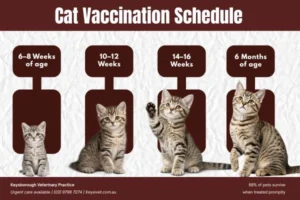
The recommended kitten vaccination schedule is as follows, with the first core vaccination administered from 6–8 weeks of age, then every 3–4 weeks until 16–20 weeks of age.
Here’s a simple breakdown:
- 6–8 weeks of age: First F3 vaccine (and FIV first dose if recommended)
- 10–12 weeks: Second F3 booster
- 14–16 weeks: Final kitten vaccination (this is the most important one: it ensures immunity has properly developed)
- 6 months of age: The WSAVA vaccination guidelines recommend a booster at 6 months to ensure a protective immune response develops in any cat who may not have responded to the initial course of vaccinations.
It’s important to follow this schedule closely: spacing matters. It is important to follow this schedule to ensure that vaccinations are effective and that your kitten’s immunity is properly established.
After the initial course of vaccinations, keep your kitten indoors for 7–10 days following their final shot. Their immune system needs that window to build proper protection before they’re exposed to diseases outside.
Adult Cat Vaccination Schedule: What Do Adult Cats Require?
Once the kitten vaccination series is complete, adult cats require ongoing booster vaccinations to ensure their immunity stays strong. Immunity from kitten vaccinations weakens over time, which is why those annual or triennial check-ins matter.
- Outdoor cats: Annual vaccination (F3 + FIV booster if applicable) is recommended to keep them protected, given their higher exposure to other cats and the environment.
- Indoor-only cats: Adult cats require a booster every 3 years for F3, though your vet will advise what’s best based on your cat’s lifestyle and risk profile. Annual vaccination every 1–3 years is the general guidance for most cats.
- FIV: Annual booster required once the primary course is complete, for cats with any outdoor access or contact with other cats.
Adult cats require this ongoing protection, even if they seem perfectly healthy. Regular booster vaccinations are also a chance to catch any health concerns early.
Do Indoor Cats Need Vaccines? (Yes: Here’s Why)
This is one of the most common questions cat owners ask, and the answer is yes. Vaccinating your cat is still important even if they never step outside. Here’s why:
- Calicivirus can travel on you: You can bring feline calicivirus in on your clothes or shoes after contact with other cats. Your indoor cat doesn’t need to go anywhere to be exposed.
- Panleukopenia is tough: Feline panleukopenia is incredibly resilient in the environment and can survive for months on surfaces. It can be carried in on shoes or clothing without you knowing.
- Vet visits are a risk: Even a routine trip to the clinic means your unvaccinated cat is in a shared environment. Ensuring your cat is up to date before any visit helps protect them and other cats in the waiting room.
- Cats escape: Even the most dedicated indoor cat can slip outside. Vaccinations help protect your cat if the unexpected happens.
Protecting your cat with core vaccines is still the responsible call, regardless of whether they’re a homebody or an explorer.
What Happens at a Cat Vaccination Appointment?
If you’re a new cat owner, the vet visit doesn’t have to feel daunting. Here’s what a standard cat vaccination appointment looks like:
- A head-to-tail health check: your vet checks eyes, ears, teeth, weight, and coat condition
- A review of your cat’s vaccination history and lifestyle
- The vaccination itself is given under the skin, which is generally less uncomfortable than injections into the muscle
- A microchip check: to make sure details are current
- A chat about any signs of illness, parasite prevention, and nutrition
It’s also a great time to ask about flea and worm prevention alongside vaccinations: something that often gets overlooked but is just as important for your cat’s quality of life.
Health checks at each vaccination appointment mean your vet can catch things early: dental disease, weight changes, lumps, before they become bigger problems.
Book Your Cat’s Vaccination at Keysi Vet
Whether you have a new kitten working through their initial course or an adult cat who’s overdue for a booster, the team at Keysborough Veterinary Practice is here to help.
We understand that every cat is different: an indoor-only cat has different needs than a cat that roams the neighbourhood. We’ll take the time to talk through your cat’s lifestyle and risk factors and tailor a vaccination plan that makes sense for them.
Book your appointment for cat vaccinations at Keysborough Veterinary Practice today: we welcome new clients and offer convenient online booking.
Frequently Asked Questions
What is the F3 vaccine for cats?
The F3 vaccine is the core cat vaccine in Australia. It protects against feline herpesvirus, feline calicivirus (cat flu), and feline panleukopenia (feline distemper). All cats and kittens should receive it.
How often does my cat need a booster vaccination?
Outdoor cats generally need an annual vaccination. Indoor-only cats may be able to go every 3 years for the F3, but your vet will advise based on your cat’s specific situation.
Does my indoor cat really need to be vaccinated?
Yes. Calicivirus and panleukopenia can be brought in on clothing and shoes. Plus, any vet visit puts an unvaccinated cat at risk. Core vaccinations are recommended for all cats.
What is FIV, and does my cat need the vaccine?
FIV (feline immunodeficiency virus) is a serious virus spread through cat bites. It’s especially relevant in Victoria, where prevalence is around 15%. If your cat goes outside or lives with cats that do, talk to your vet about the FIV vaccine.
When should I start vaccinating my kitten?
Kitten vaccinations start at 6–8 weeks of age, with boosters at around 10–12 weeks and 14–16 weeks. It’s important to follow this schedule so your kitten builds proper immunity before venturing outside.
