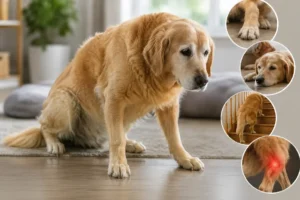


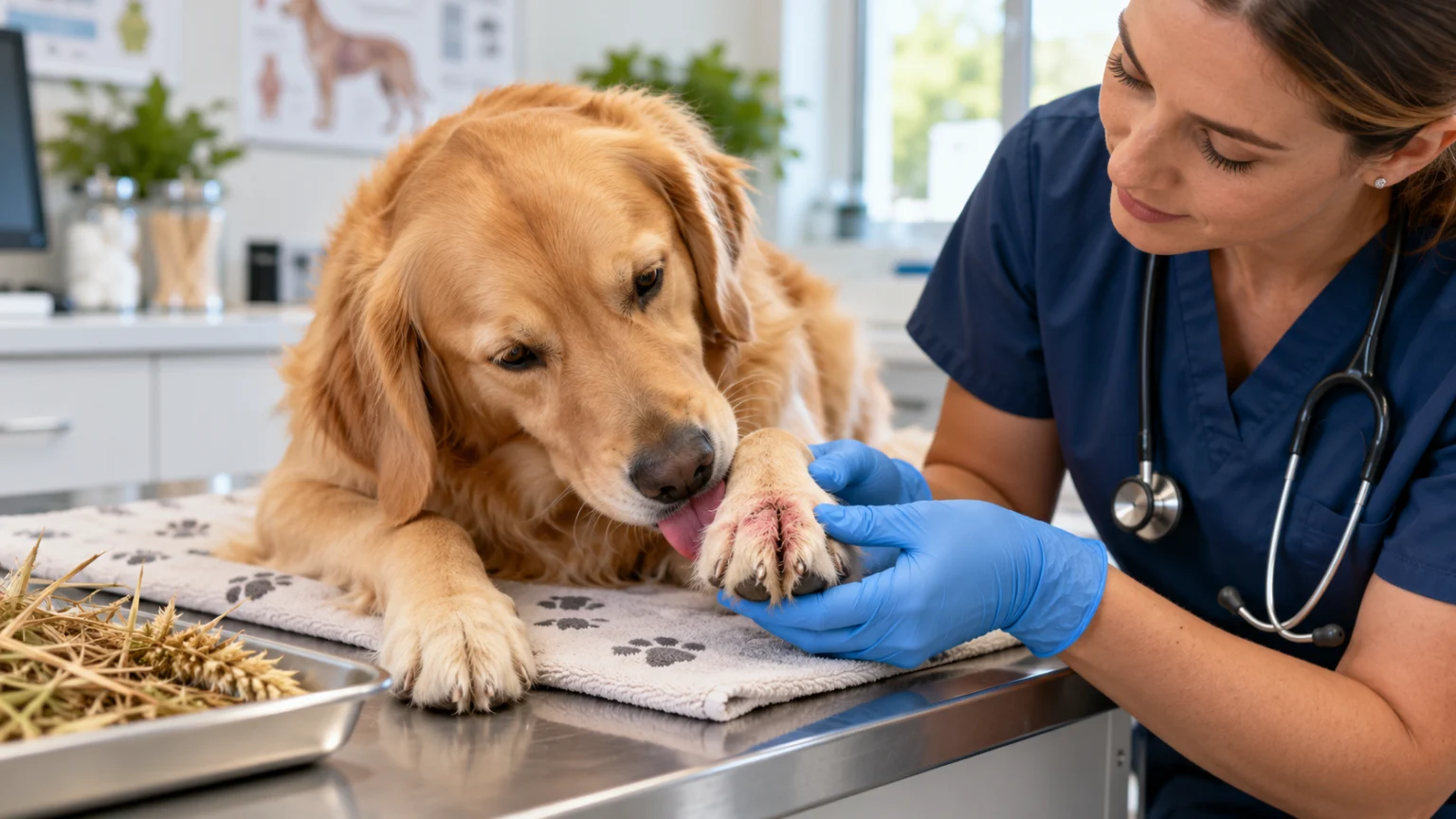
A dog licking one paw suddenly after a walk may have a grass seed, splinter, cut, nail injury or sting. A dog persistently licking several paws may be itchy from an allergy, parasites or a skin infection. The pattern is useful, but it cannot identify the cause with certainty.
For a dog licking paws, Melbourne weather and walking conditions can affect exposure, but location alone does not diagnose an allergy or a grass seed.
Spring and summer around south-east Melbourne add grass awns, pollen, wet ground and more outdoor exposure to the list. In this guide, we explain what to check safely, which signs suggest a foreign body, how allergy and infection create a licking cycle, and when our Keysborough team should examine the paws.
Start with one paw or several paws
This is not a perfect rule, but it helps organise the possibilities.
| Pattern | Causes we may consider |
| Sudden licking of one paw | Grass seed, cut, sting, torn nail or other injury |
| Licking both front paws | Allergy, contact irritation or habitual licking |
| All four paws affected | Environmental or food allergy, parasites, infection |
| One recurring toe swelling | Foreign body, nail problem, cyst or local infection |
| Paws plus ears or belly | Allergy with possible secondary infection |
| Licking with limping | Pain, foreign body, pad or joint injury |
A dog can have more than one problem. An allergy can weaken the skin barrier; then licking and moisture encourage yeast or bacteria. A grass seed can enter skin already irritated by allergy.
Why Melbourne spring and summer matter
Dry grasses produce pointed seeds that can catch in fur and travel into skin, ears, noses or beneath eyelids. Dogs with long hair between the toes can carry seeds home without the owner seeing them at first.
Animal Welfare Victoria explains that grass seeds can penetrate between dogs’ toes, lodge in ears or noses, and cause ongoing pain if they embed more deeply. It advises prompt veterinary care for relevant signs.
Pollen and plant contact can also increase seasonal itch in susceptible dogs. Rain does not directly create every infection, but wet paws and repeated licking keep skin moist and damaged.
How do I check the paw safely?
Choose good light and stop if your dog is painful or likely to bite. Pain can change behaviour quickly, even in a normally relaxed dog.
If it is safe:
- Compare the affected paw with the opposite paw.
- Look at the pads and between every toe.
- Check around each nail and dewclaw.
- Part long hair to look for redness, swelling or discharge.
- Feel gently for heat without squeezing a lump.
- Look for a surface seed, thorn or cut.
- Note whether your dog can bear weight.
Do not probe a hole, squeeze swelling or dig for a seed. A grass awn can break or move deeper. If an object is firmly embedded, near a nail or not clearly superficial, call us.
Signs of a grass seed in the paw
Grass seeds can be difficult to see once they enter the skin. Signs may include:
- sudden, focused licking after walking through long grass
- limping or holding one paw up
- redness between two toes
- a small puncture or draining hole
- local swelling that improves and returns
- pain when one spot is touched
- a firm lump between the toes
- discharge or blood
A seed’s shape can encourage forward movement through tissue. The original entry point may close while inflammation continues deeper. Waiting for it to “work its way out” can make retrieval harder.
What does allergy-related paw licking look like?
Allergy often affects more than one paw and may recur in a seasonal pattern. The face, ears, belly or armpits can also be itchy. Skin may look pink, saliva-stained, greasy or thickened after repeated episodes.
VCA’s veterinary guidance notes that itchiness is a common reason for paw licking and identifies allergy and parasites among possible causes. Once licking damages the skin, bacterial or yeast overgrowth can add more itch.
Clues worth recording include:
- whether signs occur in the same season each year
- changes after particular walking routes
- ear infections or head shaking
- flea-prevention history
- diet and treats
- response to previous medicines
- other pets or people with skin problems
These details guide assessment, but an internet symptom list cannot separate environmental allergy, food reaction, contact irritation and parasites reliably.
Could it be an infection?
Infection can be primary in a wound or secondary to licking and allergy. Paws provide warmth and moisture, especially between toes.
Signs include:
- strong or yeasty odour
- greasy or sticky skin
- pustules, crusts or sores
- brown saliva staining
- discharge between toes
- increasing redness and swelling
- pain that is worsening
Do not use leftover antibiotics, antifungal cream or another dog’s ear medication. The organism and underlying trigger matter, and licking means products are likely to be swallowed.
Our article on skin infections in dogs explains why moisture is often a contributing condition rather than the whole diagnosis.
Other causes we consider
Paw licking can also result from:
-
Nail and pad injuries
A split nail, worn pad, burn or cut may be obvious only after the paw is cleaned and examined. Road surfaces can become hot enough to injure pads, while sharp debris can lodge in them.
-
Parasites
Fleas, mites and ticks can cause itch or inflammation. A tick may hide between toes, although paw licking alone does not establish tick paralysis.
-
Pain higher in the limb
A dog may lick over the paw when discomfort originates in a toe, joint, tendon or nerve. Limping, stiffness and reduced activity help us look beyond the skin.
-
Compulsive or displacement behaviour
Boredom, anxiety and habit can contribute, but medical causes should be assessed first. Labelling licking as behavioural too early can leave pain or itch untreated.
-
Masses and interdigital lesions
Lumps, cyst-like swellings and abnormal tissue need examination. Do not assume every lump is a grass seed or abscess.
What can I do after a walk?
Routine checks can reduce the chance that a surface seed remains hidden.
- Walk on maintained paths when dry grass is seeding heavily.
- Check between toes, around ears, armpits and groin after walks.
- Comb long coat and remove loose surface seeds carefully.
- Keep paw hair at a manageable length with safe grooming.
- Rinse mud or irritants with clean lukewarm water.
- Dry between the toes gently.
- Maintain veterinarian-recommended parasite prevention.
Do not cut close to the skin with scissors when mats or seeds are tight. Skin can be pulled into the mat and injured. Ask a professional for help.
Should I use boots or paw balm?
Dog boots may reduce contact on selected walks if correctly fitted and introduced gradually. They can also trap heat and moisture, rub skin or hide a developing problem. Remove them after the walk and inspect the paws.
Paw balms vary. They do not prevent an embedded grass seed or treat allergy. Some ingredients are unsuitable when licked, so ask before applying a product to damaged skin.
Protection should not replace route choice and physical inspection.
When should I call the vet?
Book an assessment when licking persists, recurs or causes skin change. Call promptly for limping, local swelling, discharge, a torn nail, suspected grass seed or marked pain.
| Sign | Suggested response |
| Brief licking, normal skin and gait | Check, rinse if needed and monitor closely |
| Recurrent licking of several paws | Arrange a routine skin assessment |
| One swollen toe space or puncture | Call for prompt examination |
| Limping, discharge or significant pain | Seek same-day advice where possible |
| Facial swelling, collapse or breathing difficulty | Seek emergency veterinary care immediately |
Our urgent care service is available during clinic opening hours. We are not staffed overnight, and a critically unwell dog may need referral to a 24-hour hospital.
What happens at the appointment?
We ask about timing, walking routes, seasonality, diet, parasite control, ear disease and previous treatment. Then we examine all paws, not only the one you noticed, as well as other itchy areas.
Depending on findings, the veterinarian may discuss:
- clipping and close inspection
- cytology for bacteria or yeast
- skin scrapings or other parasite tests
- careful foreign-body exploration
- imaging when a deeper object or bone problem is suspected
- allergy investigation or a structured diet trial
- medicine for pain, inflammation or confirmed infection
Sedation may be recommended when a painful paw must be examined or explored without causing distress and movement. The plan is based on what the examination shows.
Why recurring paw problems need a longer plan
When we assess a dog licking paws, Melbourne owners often describe several flares that looked alike but did not necessarily share one cause.
Removing one grass seed solves that foreign body. It does not treat an unrelated allergy. Treating secondary infection settles the flare but may not prevent recurrence if the skin remains itchy.
For recurring cases, we separate:
- The trigger, such as allergy or parasite exposure.
- The secondary problem, such as bacterial or yeast overgrowth.
- The maintaining behaviour, including licking.
- Environmental exposure and paw care.
This gives the owner a plan for the next flare instead of a different guess each season.
Call our Keysborough veterinary team
If you are searching because of a dog licking paws in Melbourne, spring conditions may be relevant, but the paw still needs an individual assessment. Keysi Vet is at 4–8 Chapel Road, Keysborough.
We see dog paw licking in Melbourne families are worried about for many different reasons, so a careful examination is the most useful place to begin.
Call us on (03) 9798 7274 and tell us whether one or several paws are involved, when it began and whether your dog is limping. For non-urgent recurring itch, you can also book a consultation online.
Frequently asked questions
1. Can I pull out a grass seed myself?
A loose seed sitting on the coat can be removed. Do not dig into a puncture or pull an embedded object when part may break off. Call us for advice.
2. Why are my dog’s paws brown?
Repeated saliva can stain light fur, but the licking cause still needs assessment. Allergy, infection, pain and habit are among the possibilities.
3. Does changing food fix paw licking?
Only when a food reaction is genuinely involved, and the trial is properly designed. Random diet changes make interpretation difficult. Discuss a structured trial with a veterinarian.
4. Can I give an antihistamine?
Do not give human medication without veterinary advice. Product, dose, health conditions and the actual cause of the itch matter.