



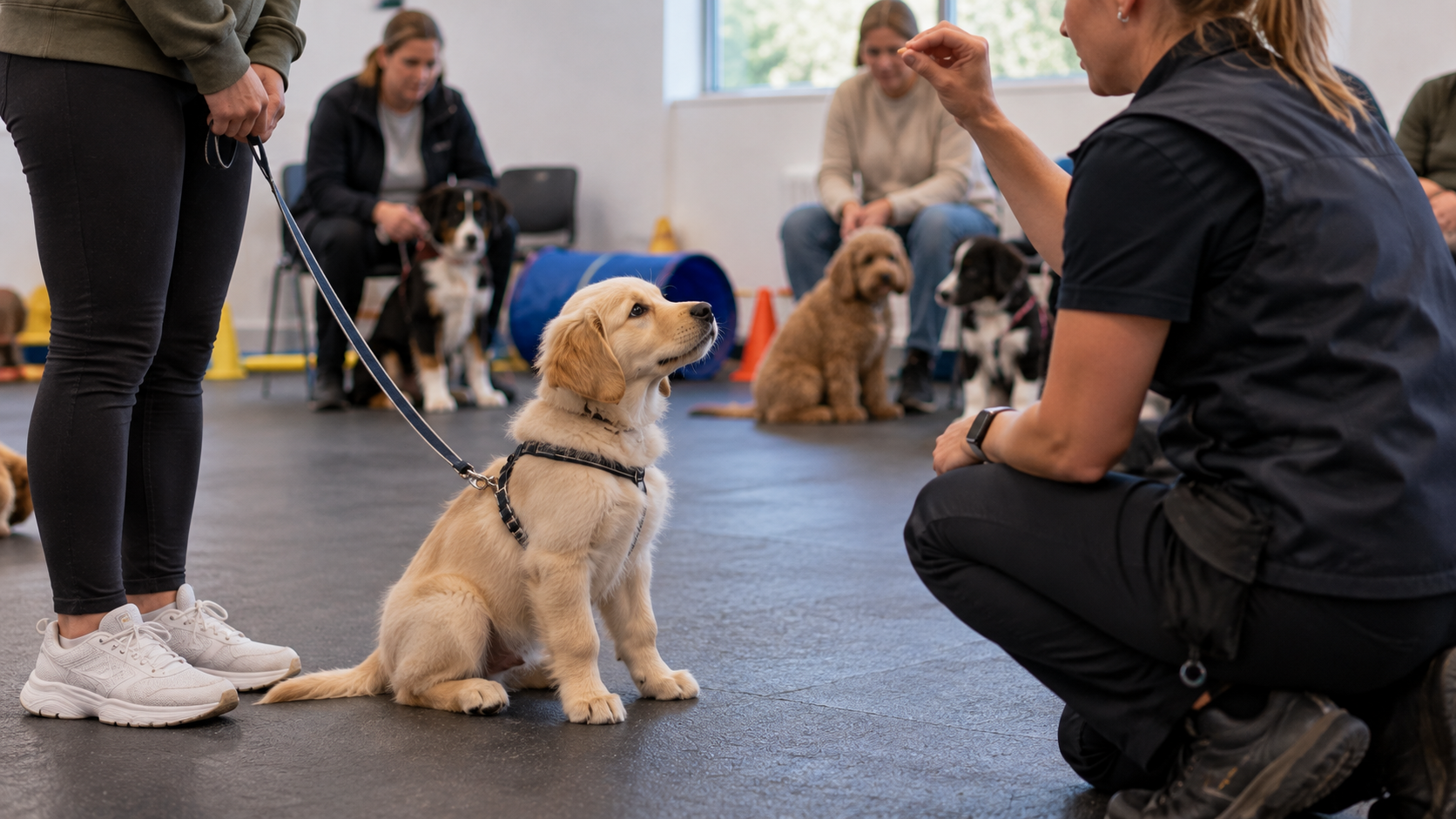
Puppy school in Keysborough is a structured introduction to learning, handling and safe social experiences during an important stage of development. A good class helps owners teach attention, recall foundations, calm greetings, settling and comfortable handling. It should also explain sleep, toilet habits, chewing, body language and how to prevent common problems rather than waiting for them to become established. Puppy school is not simply free play, and it does not guarantee that every puppy will become confident in every situation. Age, health and vaccination requirements need to be checked before attendance. If you are considering puppy school in Keysborough, call the clinic early, ideally soon after bringing your puppy home. We can confirm the current intake arrangements, discuss vaccination timing and tell you what to bring without asking you to guess from general advice online.
The first weeks with a puppy are full of small decisions that shape everyday life: where they sleep, how they greet people, what happens when they bite during play and whether they can settle when nothing exciting is happening.
Our puppy school in Keysborough helps owners practise those skills in a structured setting. In this guide, we will explain what a useful class covers, how socialisation differs from uncontrolled play, when to enquire and what to do before the first session.
What is puppy school actually for?
Puppy school gives you a supported place to teach early skills while learning to read your puppy’s behaviour. The larger goal is not a perfect performance in class. It is helping your puppy cope with ordinary life and helping you respond consistently.
The Australian Veterinary Association explains that early socialisation and appropriate puppy preschool experiences can support behavioural development when health risks are managed appropriately.
A class may work on:
- responding to a name and choosing to pay attention;
- recall foundations;
- sitting, waiting and moving with the owner;
- settling on a mat;
- gentle handling of paws, ears and mouth;
- calm exposure to people, sounds, surfaces and other puppies;
- appropriate play and interruption;
- toilet routines, chewing and sleep; and
- recognising fear, over-excitement and the need for a break.
These are foundations. They still need short, regular practice at home and in carefully chosen real-life situations.
Socialisation is more than meeting other dogs
Socialisation means helping a puppy form safe, appropriate responses to the world. Other dogs are one part of that world, not the whole programme.
Useful experiences can include:
| Experience | What the puppy can learn |
| Different people at a comfortable distance | New appearances do not always require approach or alarm |
| Household and traffic sounds | Sounds can occur without predicting danger |
| Surfaces such as mats, grass and smooth floors | Movement and footing can change safely |
| Brief gentle handling | Examination and grooming can be approached gradually |
| Seeing calm dogs | Another dog can be present without immediate play |
| Short periods of rest | Excitement can be followed by settling |
The aim is not maximum exposure. A frightened puppy forced to remain close to something overwhelming may learn that the situation is unsafe. Quality, distance and the puppy’s response matter more than ticking items off a list.
The American Veterinary Society of Animal Behaviour’s puppy socialisation statement emphasises carefully managed early exposure rather than waiting until every possible vaccination has been completed. The right balance depends on local disease risk, the puppy’s health and how the class is managed, so ask us before attending.
Is puppy school just supervised play?
No. Play can be useful, but unrestricted play is not suitable for every puppy or every moment. Size, confidence, play style and arousal all affect whether an interaction is helpful.
A puppy that hides, freezes or repeatedly tries to escape is not learning confidence by being kept in the group. A puppy that continually overwhelms others is not learning polite play simply because it appears happy.
Structured classes use pauses, distance and owner engagement. Some puppies may watch rather than interact. That can still be a productive session.
When should you enquire about puppy classes?
Call soon after your puppy comes home. Current intake ages, availability and vaccination requirements need to be confirmed with the clinic, and leaving the enquiry until later can mean missing the relevant developmental window or the available class.
Your puppy also needs individual veterinary advice. Bring or request records from the breeder, shelter or previous clinic. We need to know which vaccines were given, on what dates and which product was recorded.
Our new puppy first-visit guide explains what to gather for that appointment. At the health check, we can discuss vaccination, parasite prevention, microchipping, feeding and any concern you noticed after the puppy arrived.
How does vaccination fit with puppy school?
Young puppies receive temporary antibodies from their mother, and those antibodies decline over time. This is why puppies receive a vaccination course rather than relying on one early dose.
Please consider this before the first class:
- Send or bring the vaccination record.
- Tell us if your puppy has vomiting, diarrhoea, coughing, nasal discharge or unusual tiredness.
- Do not attend if the puppy is unwell unless the team has assessed the situation and advised otherwise.
- Ask where to toilet the puppy and how the class area is cleaned.
- Follow the clinic’s arrival instructions rather than letting puppies greet in the car park.
Our vaccination and wellness service explains the clinic’s published puppy vaccination protocol. The vet can adjust advice to the records and puppy in front of us.
What should you bring to puppy school?
The clinic will confirm its current requirements. A practical class kit commonly includes:
- a secure flat lead and correctly fitted collar or harness;
- small, high-value food rewards your puppy tolerates;
- a mat or towel if requested;
- waste bags;
- water and a bowl if requested;
- the vaccination record; and
- any information about food sensitivity, fear or previous incidents.
Avoid arriving with a retractable lead unless the class specifically asks for one. It is harder to manage distance safely in a group.
Do not feed a large meal immediately before class. At the same time, do not withhold food in a way that is unsuitable for a very young puppy. Ask what reward and feeding plan fits the session.
What might your puppy learn in class?
The exercises should connect to daily life rather than exist only for the class hour.
-
Attention and name response
The puppy learns that turning towards you is worthwhile. This supports later recall and helps you redirect attention before the lead becomes tight or excitement takes over.
-
Recall foundations
Early recall begins with short, easy distances and a strong reward history. It is not a test in an uncontrolled park. Keep the puppy secured unless the environment and instructor make off-leash practice appropriate.
-
Calm greetings
Not every person or dog needs to be greeted. Puppies can learn to approach with four paws on the floor, pause, or move past and stay connected to the owner.
-
Settle and recovery
Learning to rest is as important as learning an action. A puppy that can recover after excitement is easier to live with and better able to learn.
-
Cooperative handling
Gentle practice around paws, ears, mouth and body can prepare a puppy for routine care. It does not mean holding them down until they stop resisting. We use small steps and watch body language.
Keysborough Veterinary Practice has Low Stress Handling certification within the team. This is a structured approach intended to reduce fear and distress during veterinary care. It fits naturally with teaching a puppy that handling can be predictable and manageable.
How do you tell if your puppy is coping?
Body language changes with context. Look at the whole puppy rather than one signal.
| More comfortable signs | Signs the puppy may need distance or a break |
| Loose body and normal movement | Freezing, crouching or trying to hide |
| Able to take food normally | Refusing familiar food in a highly aroused state |
| Brief investigation followed by return to owner | Repeated escape attempts or inability to disengage |
| Play with pauses and role changes | One-sided chasing, pinning or persistent avoidance |
| Able to settle after activity | Escalating barking, biting or frantic movement |
Panting can mean heat, exertion or stress. Tail movement does not always mean relaxation. Ask the instructor what they are seeing and how to respond.
What if your puppy is shy?
A shy puppy does not need to be passed from person to person. They may begin behind a barrier, at a greater distance or by observing.
Give them a choice where safety allows. Reward noticing and recovering, not only approaching. A class can be adapted, but some puppies benefit from an individual plan before or alongside a group setting.
Tell us about hiding, growling, snapping, panic in the car or severe distress before the first session. Growling is information. Punishing it can remove the warning without changing the underlying fear.
What if your puppy is very excited?
An outgoing puppy can still be overwhelmed. Barking, pulling, and hard play may reflect arousal rather than confidence.
Use distance, short turns and rest. Reward attention before allowing an appropriate greeting. If the puppy cannot settle, leaving early can be better than rehearsing frantic behaviour for the rest of the session.
Sleep matters too. Young puppies need substantial rest, and overtired behaviour can look like endless energy. Build quiet time into the day rather than adding more activity whenever the puppy becomes difficult.
What puppy school cannot promise
Puppy school cannot guarantee future behaviour, prevent every fear or replace veterinary care. Genetics, early history, health, learning and later experiences all matter.
It also does not replace urgent advice. Contact us if your puppy is unwell, will not eat, repeatedly vomits, has diarrhoea, struggles to breathe or becomes suddenly weak. Do not attend class to ask about an acutely unwell puppy.
For behaviour that involves biting with injury, severe separation distress, persistent guarding or intense fear, ask whether a veterinary assessment and individual behavioural support are more appropriate.
Keep practising between classes
Short practice works better than one long session. Fit learning into normal routines:
- reward the puppy for checking in during a walk;
- practise settling while you prepare a meal;
- touch one paw briefly, reward and stop;
- call the puppy over a short distance indoors;
- let them watch the world from a safe distance; and
- end while the puppy can still succeed.
Every family member should use the same cues and rules. Consistency makes the behaviour easier to understand.
Keep identification current as your puppy begins exploring. Our Victorian pet microchipping guide explains the difference between having a chip and keeping the registry details correct.
Ask about puppy school in Keysborough
Keysborough Veterinary Practice is independent and owner-operated and has been on Chapel Rd since 1988. We can connect your puppy’s health, vaccination and early learning rather than treating them as unrelated jobs.
Call (03) 9798 7274 to ask about the current puppy school intake, eligibility and what to bring. Because dates, availability and class arrangements can change, our team will give you the current details rather than asking you to rely on an old timetable.
Frequently asked questions
1. What age should a puppy start school?
The appropriate age and vaccination requirements depend on the class and the puppy’s health record. Enquire early so the clinic can confirm current eligibility.
2. Can a shy puppy attend?
Possibly. The plan may use distance, observation and shorter participation. Tell the team before class so the environment can be considered.
3. Does puppy school teach toilet training?
It can teach owners how to build a routine, supervise and reward the right behaviour. Most toilet training still happens at home through consistent practice.
4. Is puppy school the same as obedience training?
It includes early learning skills, but its scope is broader. Handling, social experiences, body language, settling and owner education are central.
5. How do I enrol in puppy school in Keysborough?
Call Keysborough Veterinary Practice on (03) 9798 7274. The team can confirm the current intake, health requirements and next steps.
