



If you’re reading this right now with a cat crying in the background, you’re probably wondering why your cat is meowing so much and whether something is actually wrong. You’re not alone. Millions of cat owners across Australia deal with this exact question every day, and the answer is not always as simple as “they’re hungry.”
Approximately 69% of Australian households own pets, with cats found in around 33% of homes RSPCA, meaning there are roughly 5.3 million pet cats across Australia. For a significant portion of cat owners, excessive meowing is a daily challenge.
Here’s the thing: meowing is an important way for cats to communicate, and there are a lot of reasons why they meow and vocalise in different ways. If your cat is starting to meow a lot more than normal, there’s a reason, and a little detective work will often help identify the likely possibilities.
This guide walks you through the 8 most common reasons behind excessive cat meowing, what different sounds actually mean, when to call a vet, and some things you can try at home first.
Quick Reference: Common Reasons for Excessive Cat Meowing
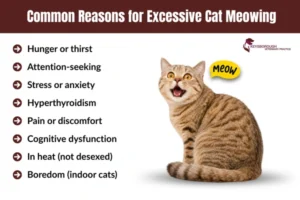
Hunger or thirst — Short, repetitive meow. Check food and water bowls.
Attention-seeking — Persistent, escalating meow. Structured playtime.
Stress or anxiety — Frequent, urgent meow. Identify and remove stressors.
In heat (not desexed) — Loud yowling. Speak to your vet about desexing.
Boredom (indoor cats) — On-and-off meowing. Environmental enrichment.
Cognitive dysfunction — Confused, especially at night. Vet assessment.
Hyperthyroidism — Constant, restless meowing. Blood test at the vet.
Pain or discomfort — Sharp, sudden cry. Vet visit promptly.
8 Reasons Your Cat Meows Excessively (and What to Do About Each)
1. Hunger or Thirst
This is one of the most common reasons cats meow, especially around mealtimes. A hungry cat may meow every time someone walks into the kitchen, hoping to be fed. An empty or dirty water bowl will also prompt your cat to vocalise.
What to try:
- Check the food and water bowls first
- Keep to a regular feeding schedule
- Try an automatic feeder to remove the anticipation cycle
2. Attention-Seeking Behaviour
Many cats learn to meow to signal their wish for attention, to go outside, or to be fed. When you give in to your cat’s demands, you’ve just trained them that the way to get what they want is through vocalising. Once this happens, the cat will continue to vocalise and might even increase the behaviour.
What to try:
- Set aside dedicated playtime each day
- Ignore the meowing and reward quiet, calm behaviour instead
- Avoid giving attention to the moment meowing starts
3. Stress or Anxiety (New Home, New Baby, New Pet)
Cats are creatures of habit, and anything that disrupts their routine can cause them real distress. Moving to a new home, bringing a new pet into the house, or even rearranging furniture can set off a period of increased meowing. Social changes such as a new home, a new cat or different people visiting the house, as well as activity outside the house that they can see and loud noises, can all make a cat meow more often and more loudly.
What to try:
- Give your cat a quiet, safe space away from the disruption
- Use pheromone diffusers designed for feline anxiety
- Introduce changes slowly wherever possible
4. They’re in Heat (Not Desexed)
An unneutered female cat in heat will yowl loudly and persistently, sometimes for days at a time. When female cats are in heat, they become extremely vocal, yowling for about a week every month. A male cat that smells a female in heat will also meow quite a bit more to try to find her.
What to try:
- Speak to your vet about getting your cat spayed or neutered
- Desexing eliminates heat cycles and has significant health and behavioural benefits
5. Boredom (Especially for Indoor Cats)
Indoor cats need mental and physical stimulation. Without it, they get bored and restless, and meowing is often how they let you know. If your cat spends many hours alone during the day, they may feel lonely. An entertaining way to alleviate loneliness is to put a bird feeder outside a window or leave different toys out for play.
What to try:
- Rotate toys regularly to keep things interesting
- Consider puzzle feeders to give your cat something to work for at mealtimes
- Window perches near bird activity can keep them entertained for hours
6. Cognitive Dysfunction in Older Cats
Just like humans can develop dementia as they age, older cats can experience a condition called Feline Cognitive Dysfunction Syndrome (FCDS). Estimates of FCDS prevalence range from 13% to 88% for cats aged 8 to 19 years, with a positive correlation between age and prevalence.
Senior cats can suffer from mental confusion or cognitive dysfunction. They can become disoriented and cry without any apparent reason, especially at night.
What to try:
- Add nightlights to reduce disorientation in the dark
- Keep the home layout consistent and predictable
- Book a vet check to rule out other medical causes
7. Hyperthyroidism
Hyperthyroidism is a common condition in senior cats that causes the thyroid gland to produce too much hormone. It leads to a range of symptoms, including increased vocalisation. It is estimated that over 10% of all senior cats will develop the disorder, and it is now recognised as the most common feline endocrine disorder. In Australia and New Zealand, feline hyperthyroidism is recognised as the most common endocrinopathy of middle-aged to older domestic cats.
What to try:
- If your older cat has started meowing constantly and seems restless or is losing weight despite eating well, book a vet visit
- A simple blood test can confirm or rule out hyperthyroidism
- Effective treatments are available, including medication and dietary management
8. Pain or Discomfort They’re Hiding
Cats are instinctively good at hiding pain, which is a survival mechanism. But excessive meowing, especially sudden or sharp cries, can be a signal that something is wrong physically. Serious health issues, such as kidney disease or urinary tract diseases like cystitis or bladder obstruction, can cause cats to meow more often. Cats in distress may also vocalise loudly while sitting on the litter box if they are experiencing urinary obstruction.
What to try:
- Watch for changes in litter box habits, appetite or movement
- Any sudden, unexplained meowing warrants a vet check, especially if accompanied by hiding or behavioural changes
Meowing vs. Yowling vs. Howling: What Each Sound Means
Not all cat sounds mean the same thing. Here’s a quick breakdown to help you read what your cat is trying to tell you:
Short meow — Greeting or a simple “hello.”
Repeated meows — Excitement or an urgent request.
Slow, drawn-out meow — A demand for food or attention.
Yowl — Pain, distress, territorial dispute, or being in heat.
Howl at night — Cognitive confusion (especially older cats), fear or disorientation.
Chirping/chattering — Watching prey (birds, insects) from a window.
Unlike meowing, adult cats do yowl at one another, specifically during breeding season. A yowl is similar to a meow but more drawn out and melodic.
Night Meowing: Why Cats Do It and What to Try
Meowing at night is one of the most disruptive things for cat owners, and it’s worth understanding the specific reasons it happens.
Common causes of night meowing include:
- Cognitive dysfunction in senior cats causes disorientation, especially in the dark
- Hunger, particularly if your cat’s feeding schedule doesn’t include a late meal
- Being in heat, which can intensify overnight
- Boredom or excess energy, especially in younger cats, not getting enough daytime activity
Practical tips for night meowing:
- Feed a small meal closer to your bedtime
- Engage in a good play session in the evening to tire your cat out
- Use nightlights if your cat is older and may be confused in the dark
- Avoid responding to the meowing, as this reinforces the behaviour
When Meowing Is a Vet Concern: Signs You Should Not Ignore
Knowing when to act is just as important as understanding the causes of excessive meowing. The following signs mean it’s time to contact a veterinarian:
- Sudden change in vocal behaviour in a previously quiet cat
- Meowing accompanied by hiding, appetite loss, or litter box changes
- Loud yowling while in or near the litter tray
- Excessive, constant meowing in a cat over 10 years of age
- Meowing alongside weight loss despite eating normally
- Any sharp, sudden crying that seems linked to movement or touch
Kidney disease, though not the most common cause of excessive meowing, can make cats more restless and vocal than when they were healthy. Hypertension may also cause cats to meow more incessantly.
If your cat is meowing more than usual and you’re based in Melbourne or the surrounding south-eastern suburbs, don’t wait to see if it passes. Some conditions, especially in older cats, are much easier to treat when caught early.
Simple Things to Try at Home First
Before heading to the vet, it’s worth working through this checklist:
- Are the food and water bowls full and clean?
- Has anything changed in the home recently (new pet, new baby, visitors, renovations)?
- Is your cat desexed?
- Are you spending time playing with your cat each day?
- Does the meowing happen at a specific time (meals, bedtime, when you leave the house)?
- Has the behaviour come on suddenly or gradually increased over time?
A sudden change in vocal behaviour should always be taken seriously. Gradual increases may be behavioural, but they can also indicate a slow-progressing medical condition that deserves a check-up.
See Your Vet at Keysborough Veterinary Practice
If you’re in Melbourne or the Keysborough area and something feels off about your cat’s behaviour, Keysborough Veterinary Practice is here to help. Our team understands that excessive or sudden changes in your cat’s vocalisation can be worrying, and we take those concerns seriously.
Whether it’s a routine wellness check, a senior cat assessment, or something that needs same-day attention, our Melbourne-based practice is experienced in both the medical and behavioural causes of excessive meowing in cats.
Book an appointment with Keysborough Veterinary Practice today and let’s make sure your cat is happy, comfortable, and in good health.
Frequently Asked Questions
1. Why is my cat meowing so much all of a sudden?
A sudden increase in meowing often points to a medical reason, stress, or a change in the home environment. It’s best to rule out health issues with a vet visit if it’s out of character.
2. Is it normal for a cat to meow constantly throughout the day?
Not really. While some cat breeds like the Siamese are naturally more vocal, constant meowing throughout the day usually signals that something is off, whether that’s boredom, hunger, anxiety, or a health condition.
3. Why does my cat meow so much at night?
Night meowing is common in older cats with cognitive dysfunction and in cats that are not desexed. It can also be a sign of hunger or excess energy. A consistent bedtime routine and play session before sleep can help.
4. At what age do cats start showing signs of cognitive dysfunction?
Behavioural changes linked to cognitive dysfunction typically emerge in cats aged 11 and older, though the condition can begin developing from around 8 years of age.
5. When should I take my cat to the vet for meowing?
If the meowing is sudden, paired with other symptoms (hiding, appetite changes, litter box issues, weight loss), or your cat is older and meowing especially at night, a vet visit is the right call.
