



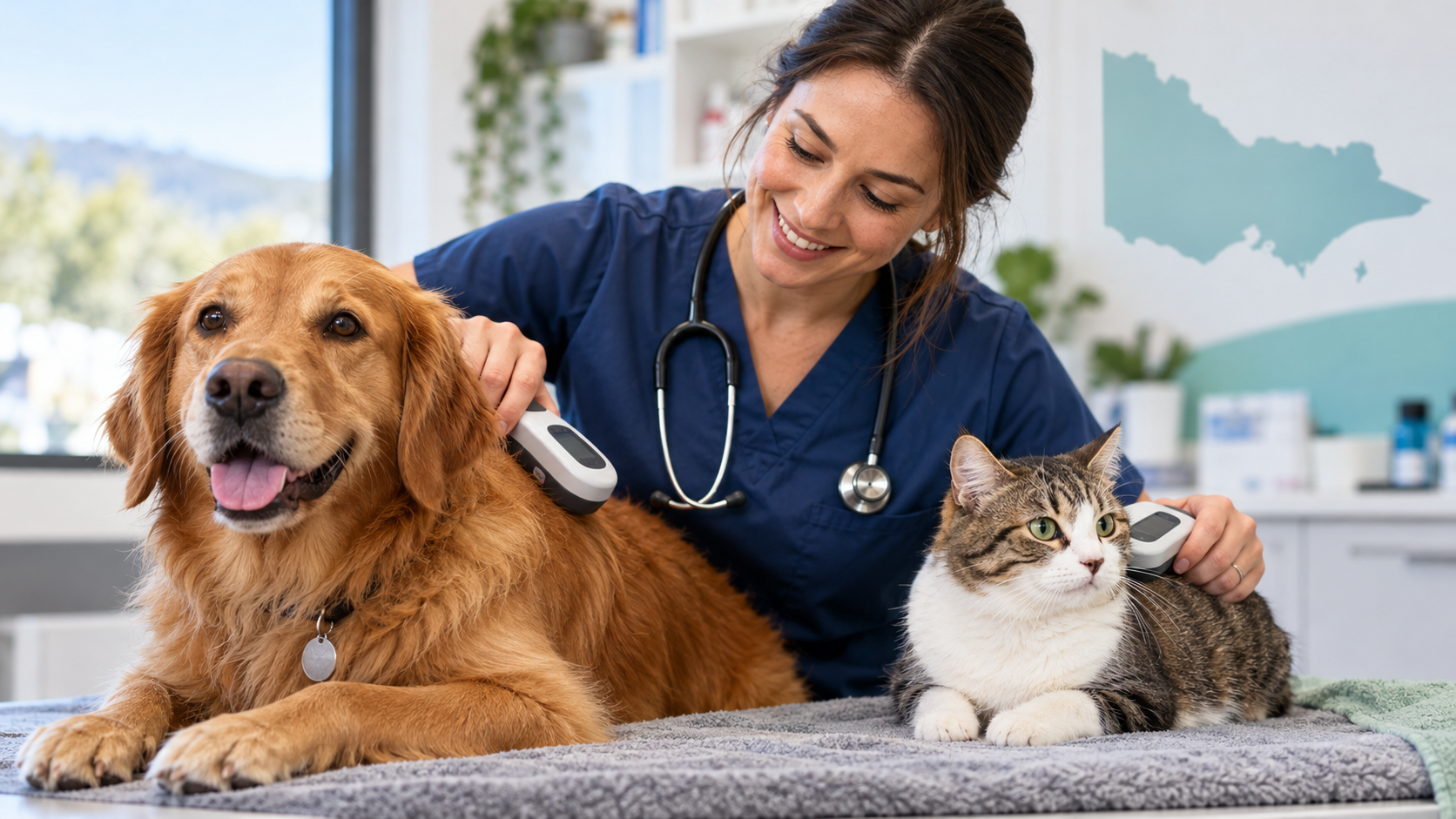
A microchip gives a dog or cat a permanent identification number, but the chip only helps reunite you when the registry details are accurate. It is not a GPS tracker; it does not replace council registration, and changing your address with the council does not necessarily update the separate microchip registry.
At Keysborough Veterinary Practice, we can scan pets, implant a microchip when appropriate and help owners understand which record needs attention. This guide explains pet microchipping in Victoria, including the legal basics, what happens during implantation, how ownership transfers work and the checks worth making after a move or adoption.
What is a pet microchip?
A pet microchip is a small electronic identification device implanted under the skin. It has no battery and does not continuously transmit a location. A compatible scanner activates it at close range and reads its unique number.
That number is linked to a record held by a licensed registry. Authorised users can use the registry information to contact an owner when a lost or injured pet is scanned.
| Microchip can do | Microchip cannot do |
| Provide a permanent identification number | Show a pet’s live location |
| Link to owner contact details on a registry | Update itself when you move |
| Help a clinic, council or shelter identify a pet | Replace a collar tag for immediate neighbourhood contact |
| Support council registration and ownership records | Store a complete medical history |
The technology is simple. The administration around it is what determines whether the number leads to the right person.
What does Victorian law require?
Animal Welfare Victoria states that cats and dogs must be microchipped before first registration with a Victorian council. It also states that dogs and cats must be microchipped before being sold or given away in Victoria. Cats and dogs aged three months and over must generally be registered with the local council, subject to the relevant legal requirements and any exemption.
Read the current government guidance on microchipping dogs and cats in Victoria and confirm local registration questions with your council. Laws and processes can change, so official information takes priority over an old checklist.
The main responsibilities can be separated like this:
- Microchip: permanent electronic identification.
- Registry record: owner and animal details linked to that number.
- Council registration: local government registration, usually renewed periodically.
- Collar and tag: visible identification where required and useful for quick contact.
Completing one step does not automatically prove the others are current.
When should a puppy or kitten be microchipped?
Many puppies and kittens are microchipped before they go to a new home because Victorian rules require microchipping before sale or transfer. If you receive a pet without clear records, arrange a scan and contact the relevant council or registry rather than assuming a chip is absent.
Microchipping can often be performed during a routine veterinary visit. Some owners also coordinate it with another planned procedure, but timing depends on the pet’s age, size, health and existing identification.
Our vaccination and wellness service covers preventive-care discussions for puppies, kittens and adult pets. Bring every document supplied by the breeder, shelter or previous owner so we can help identify gaps.
What happens during the appointment?
Before implantation, the authorised implanter scans the animal to check for an existing chip. Implanting a second chip without an appropriate reason can create conflicting records.
The basic process is:
- confirm the animal and owner information
- scan the usual areas for an existing microchip
- discuss the procedure and any relevant health concerns
- implant the chip under the skin using a sterile applicator
- scan again to confirm that the number reads
- complete the required registry paperwork
- provide or arrange identification documentation
The injection needle is larger than a vaccination needle, and animals may react briefly. We do not call any procedure painless. Restraint, timing and the individual pet’s temperament affect how the appointment is managed.
What information should you check afterwards?
When the registry confirmation or certificate arrives, do not file it unread. Check:
- microchip number
- pet’s name, species, breed and sex
- desexing status where recorded
- owner’s full name
- home address
- primary and backup phone numbers
- email address
- emergency contact
- registry name and update instructions
Scan or photograph the certificate and store it somewhere searchable. Keep the original with vaccination, desexing, adoption and council records.
How do I find out which registry holds the chip?
If you have the microchip number but not the registry, an authorised scanner or relevant lookup process can help identify where the number is recorded. Do not publish the full number or personal details publicly while asking for help.
A veterinary clinic can scan the pet and give you the number. Ownership and registry access rules may limit what staff can change on your behalf. The registry may need identity evidence, a transfer form or contact with the previous owner.
If paperwork is missing, start early. It is easier to resolve ownership records while the previous keeper, breeder or rescue remains contactable than during an emergency.
Moving house: two records may need updating
When you move, update both:
- The licensed microchip registry holding the chip record.
- The local council registration, including transfer to a new municipality where required.
Animal Welfare Victoria’s guidance for caring for cats specifically reminds owners to update both council and microchip registry details after moving.
Also update phone numbers, email and the emergency contact. A correct street address with an old disconnected mobile can still delay reunification.
Buying, adopting or receiving a pet
The seller, breeder, shelter or person giving away the animal should provide microchip and transfer information. Check that the animal presented matches the documents and arrange a scan at the first veterinary visit.
Bring:
- adoption or sale agreement
- microchip certificate or transfer form
- vaccination history
- desexing certificate if relevant
- council information supplied
- source number information where applicable
- previous veterinary records
Do not assume the transfer completed merely because a form was signed. Look for registry confirmation in your own name and follow up if it does not arrive.
What if the previous owner will not complete the transfer?
Contact the registry for its dispute or statutory-declaration process and gather lawful evidence of ownership. The veterinary clinic generally cannot decide an ownership dispute or alter registry details without authority.
Evidence may include a sale or adoption contract, payment record, council registration, veterinary history and written communication. Contact your local council for guidance on responsibilities and legal process.
Avoid implanting another chip as a shortcut. Two numbers can create more confusion and do not by themselves, resolve ownership.
What if the scanner cannot find a chip?
A chip can occasionally migrate from the original implantation area, so a systematic scan covers more than one small spot. Scanner technique and equipment matter. If no number is found, we consider the records, previous certificates and whether repeat scanning is warranted.
Possible explanations include:
- the pet was never microchipped
- the chip has migrated
- the chip is not reading normally
- the supplied number belongs to another animal
- the scan was too limited
- documentation is incorrect
Animal Welfare Victoria notes that a second chip should not be implanted unless the original is not working, does not uniquely identify the animal or has migrated outside the scanning region. An authorised implanter can advise on the proper next step.
Does a microchip replace a collar and tag?
No. A visible tag lets a neighbour call you without taking the animal to a scanner. A microchip remains important because collars can come off and tags become unreadable.
Use both where safe and appropriate. Follow council rules about registration tags and keep the visible phone number current. For cats, choose a suitable breakaway collar if a collar is used and discuss safety with your vet.
Why microchips matter in urgent care
When an injured animal arrives without an owner, scanning can help identify the person authorised to make treatment decisions. It can also reveal that a “stray” pet lives only streets away.
Our urgent care service operates during clinic opening hours. We are not a 24-hour hospital. If you find an injured animal, call the relevant council or us first where possible so the safest destination and transport can be discussed.
Do not put yourself at risk handling an injured, frightened animal. Even a normally gentle pet may bite when in pain.
A yearly microchip check
Make the chip record part of an annual routine:
- ask for a scan during a suitable veterinary visit
- compare the number with the certificate
- log in to the registry and review contacts
- check council registration separately
- replace worn collar tags
- update the backup contact
- save the registry login and certificate securely
A scan confirms the chip reads. It does not confirm every registry field is current, so both checks matter.
Common mistakes we help owners untangle
The same problems occur repeatedly:
| Situation | Useful next step |
| Chip exists, but owner details are old | Contact the named registry and follow its update process |
| New owner has no transfer confirmation | Contact seller and registry with ownership documents |
| Council registration is current, but registry is not | Update the registry separately |
| Number on certificate does not match scan | Ask the clinic and registry to investigate before changing records |
| Pet has two chip numbers | Keep both documented and seek registry/council guidance |
| Pet is lost | Notify council, registry and local shelters; mark the registry record appropriately |
Do not wait until the pet is missing to discover which login or signature is needed.
Arrange pet microchipping in Keysborough
For pet microchipping, Victoria owners can rely on current government guidance, accurate registry details and a chip that scans correctly. Keysborough Veterinary Practice is at 4–8 Chapel Road, Keysborough, and we provide microchipping as part of dog and cat preventive care.
Call us on (03) 9798 7274 to arrange an appointment or ask whether microchipping can be combined with another planned visit. Bring all existing paperwork. For routine care, you can also use our online booking option.
Frequently asked questions
1. Is a microchip a GPS tracker?
No. It is read by a scanner at close range and links to registry details. It does not show a live location.
2. Does the chip expire?
It is designed as permanent identification and has no battery. Records and contact details still need maintenance, and chips can occasionally be difficult to locate or read.
3. Can I update details through the council only?
Council registration and microchip registry records are separate. Update both when relevant.
4. Can a vet transfer ownership for me?
The clinic can scan and provide appropriate documentation, but the registry’s identity and transfer process controls ownership changes. Contact the registry for the required steps.
