



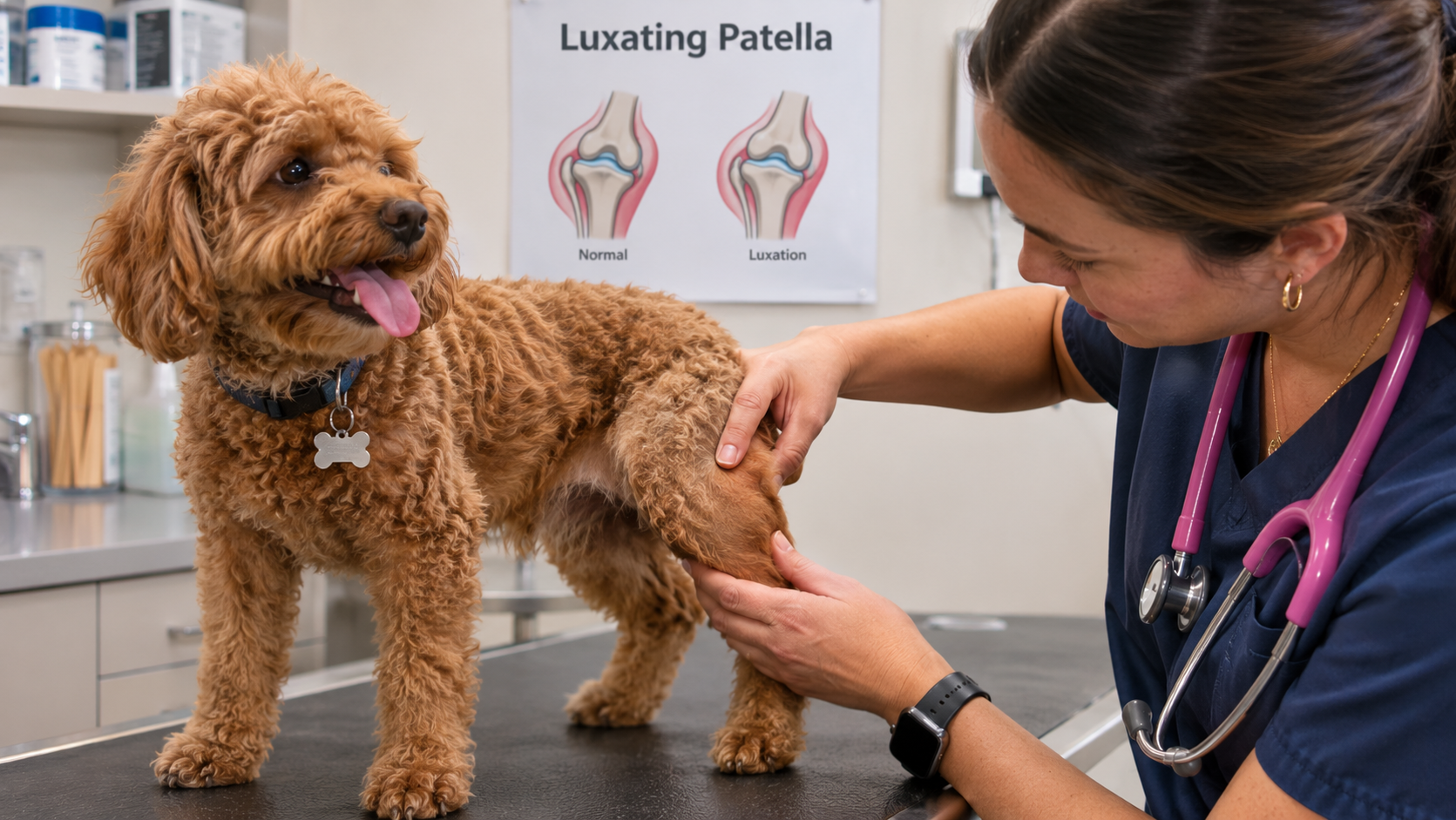
A luxating patella is a kneecap that moves out of its normal groove. In dogs, it can cause a characteristic skip: the dog briefly lifts a back leg, takes several steps on three legs and then walks normally again. Some dogs show few signs, while others develop frequent lameness, pain, an abnormal gait or arthritis over time. A skipping leg is not enough to diagnose the condition because paw injuries, cruciate ligament disease, hip problems and other causes can look similar. Keep your dog on controlled activity and book a veterinary examination if the skipping repeats. Seek urgent care after trauma if the dog cannot bear weight, is in marked pain, or the leg looks deformed. Treatment can range from monitoring and weight management to surgery, depending on the examination, severity and effect on the individual dog.
Owners often describe luxating patella in dogs as “running normally, then hopping for a few steps”. The movement can be so brief that it is difficult to show us in the consultation room.
This guide will explain what the kneecap is doing, which patterns matter, how we examine the knee and why a diagnosis does not automatically mean surgery. It will also show you what to record at home before an orthopaedic assessment in Keysborough.
What is a luxating patella in dogs?
The patella is the kneecap. It normally glides within a groove at the end of the thigh bone as the knee bends and straightens. Luxation means it moves out of that groove.
The kneecap may move towards the inside of the leg, called medial luxation, or towards the outside, called lateral luxation. The direction, frequency and ease with which it moves are part of the veterinary assessment.
This is not simply a loose object floating around the joint. Limb alignment, the depth of the groove, soft-tissue tension and the attachment of the patellar tendon can all contribute.
What does a slipping kneecap look like?
Signs vary from occasional skipping to persistent lameness.
| What you notice | What it may mean |
| Briefly holding up one back leg, then returning to normal | The kneecap may move out and back into position |
| Repeated skipping during a walk or run | Luxation may be occurring more frequently |
| Crouched or unusual back-leg posture | Both knees or wider limb alignment may be involved |
| Reluctance to jump or use stairs | Pain or joint instability may be affecting function |
| Sudden continuous lameness | Another injury, including cruciate disease, must be considered |
| Stiffness that increases over time | Joint inflammation or arthritis may be developing |
A short video of the natural gait can be useful. Record from the side and behind only if your dog moves voluntarily. Do not run a painful dog up and down to capture the skip.
Is luxating patella only a small-dog problem?
It is commonly recognised in smaller breeds, but dogs of different sizes can be affected. The causes and direction of luxation may differ, and size alone does not tell us how much the condition affects the dog.
Do not compare two dogs only by breed. One may have an incidental mild finding with no functional problem, while another may have pain, frequent displacement and changes to limb alignment.
The examination focuses on the dog in front of us: age, body condition, gait, pain, joint stability, frequency and the presence of other orthopaedic problems.
Could a skipping back leg be something else?
Yes. A skipping gait is suggestive, not conclusive. Other possibilities include:
- a thorn, cut or grass seed in the paw;
- a torn nail;
- muscle or tendon injury;
- cranial cruciate ligament disease;
- hip or spinal pain;
- another knee injury;
- a fracture after trauma; or
- a neurological problem affecting limb use.
Our guide to why a dog may limp explains the wider decision. A vet needs to examine the full limb because the most obvious joint is not always the source of pain.
When does the problem need urgent care?
Intermittent skipping in a bright, comfortable dog can usually be booked as a planned appointment. Call sooner if the frequency is increasing or your dog seems painful.
Seek urgent advice if:
- the dog cannot bear weight;
- the leg looks deformed or hangs unusually;
- the problem followed a fall, collision or other trauma;
- the knee is markedly swollen;
- your dog cries, pants or cannot settle because of pain;
- weakness affects more than one leg; or
- the dog is otherwise unwell.
Keysborough Veterinary Practice provides daytime urgent care during opening hours, not overnight care. Call (03) 9798 7274 before travelling so we can assess the urgency and prepare or direct you appropriately.
Do not give human pain medicine. Products that people take routinely can be dangerous to dogs.
How is a luxating patella diagnosed?
Diagnosis begins with history, observation and a hands-on orthopaedic examination. We ask when the skipping began, how often it occurs, whether both legs appear involved and what activities change it.
The vet may:
- watch the dog stand, walk and turn;
- examine the paw and full limb;
- assess hip and knee movement;
- feel whether the patella moves out of its groove;
- assess pain and muscle development;
- check cruciate-ligament stability; and
- compare both back legs.
The patella can sometimes be moved during examination in a dog that shows little difficulty at home. That finding must be interpreted with function, discomfort and other joint findings.
What do the grades mean?
Veterinarians commonly describe patellar luxation in grades. A grade helps communicate how readily the kneecap moves and whether it stays displaced, but it is not the only treatment decision.
| General grade description | Typical finding |
| Grade 1 | Kneecap can be moved out during examination but returns to position |
| Grade 2 | Kneecap moves out intermittently and may remain out temporarily |
| Grade 3 | Kneecap is out much of the time but can be returned manually |
| Grade 4 | Kneecap remains displaced and cannot be returned to the normal groove manually |
This table is a plain-language overview, not a method for grading at home. Forcing the kneecap can hurt the dog and does not show the full alignment of the limb.
Will my dog need X-rays?
X-rays may be recommended to assess the knee, limb alignment, arthritis or another suspected cause of lameness. They do not replace the physical examination, and not every mild finding needs the same imaging plan.
Accurate positioning matters. Sedation may be discussed if pain, fear or movement would prevent useful images. We explain why it is proposed and what it may add before proceeding.
Keysborough Veterinary Practice offers pet X-rays and ultrasound on site. X-rays are generally more relevant to bone alignment and joint structure in this situation; ultrasound answers different soft-tissue questions and is not automatically required.
Complex alignment questions may require additional imaging or referral. We will explain when the information needed goes beyond an ordinary radiograph.
Does luxating patella in dogs always need surgery?
No. A dog with a mild, incidental finding and no meaningful lameness may be monitored. A dog with repeated pain, functional difficulty, progressive changes or a more severe structural problem may be considered for surgery.
Non-surgical management may include:
- keeping the dog at an appropriate body condition;
- controlled exercise suited to the dog;
- a rehabilitation plan where recommended;
- prescribed pain relief when clinically appropriate; and
- monitoring the frequency and effect of episodes.
These steps do not physically deepen a shallow groove or permanently realign the kneecap. They support comfort and function in dogs where monitoring is appropriate.
Surgery may involve more than one technique because several structures can contribute. The procedure selected depends on alignment, grade, skeletal maturity and the individual joint. Our general and orthopaedic surgery service includes luxating patella surgery, and an orthopaedic surgery consultant works with the practice.
An assessment comes before a recommendation. We do not assume that a skipping dog needs an operation.
What can you do while waiting for the appointment?
Keep activity controlled. Use a lead outside, prevent repeated jumping and avoid slippery floors where practical. Do not repeatedly bend the knee or try to push the kneecap into place.
Prepare:
- a video of the natural gait;
- the date you first noticed it;
- how many episodes occur in a day or week;
- which leg appears involved;
- any fall or rough activity before it began;
- current medicines and supplements; and
- previous X-rays or veterinary records.
If the dog worsens, cannot use the leg or becomes distressed, call rather than waiting for the scheduled visit.
What happens after surgery if it is recommended?
Recovery instructions depend on the procedure and dog. Restricted activity, wound care, prescribed medicine, follow-up examinations and a gradual return to movement are commonly involved.
The difficult part for many families is preventing a dog from doing too much when they begin to feel better. Prepare a small recovery area, non-slip footing and a plan for controlled toileting before the operation.
Call if the wound becomes swollen, opens, bleeds or produces discharge, or if the dog seems markedly painful or unwell. Do not change medicine or exercise progression without advice.
Book an orthopaedic assessment in Keysborough
A dog skipping on a back leg may have a luxating patella, but the same pattern can arise from other problems. An examination is the way to separate them.
Our independent, owner-operated clinic has worked from 4-8 Chapel Rd, Keysborough since 1988. We have in-house X-ray facilities and an orthopaedic surgery consultant on the roster. Call (03) 9798 7274 or use online booking for a stable, planned assessment. For sudden severe lameness during opening hours, call first.
Frequently asked questions
1. Can a luxating patella correct itself as a puppy grows?
The significance can change as a puppy grows, but structural luxation should be assessed rather than assumed to disappear. Monitoring and treatment depend on development and signs.
2. Is a luxating patella painful?
It can be. Some dogs show little obvious discomfort, while repeated displacement, cartilage wear or arthritis can cause pain and reduced function.
3. Can both knees be affected?
Yes. The vet examines both back legs even when the owner notices skipping on only one side.
4. Will exercise make it worse?
Uncontrolled jumping and twisting may aggravate symptoms in an affected dog. Suitable activity depends on severity and treatment plan, so request individual advice.
5. What is the difference between luxating patella and a cruciate tear?
They involve different knee structures but can both cause back-leg lameness and may occur together. A hands-on stability examination helps distinguish them.
