



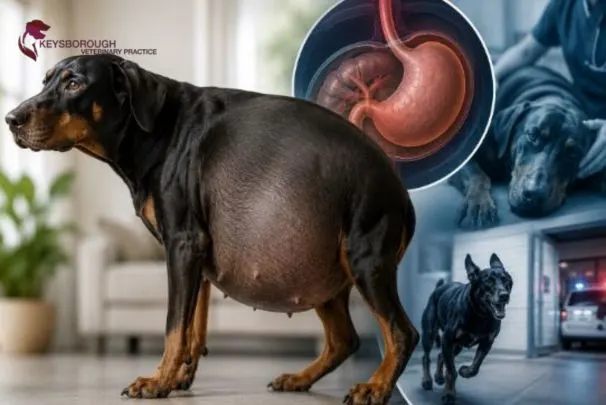
If your dog’s abdomen looks suddenly swollen or hard, and they’re retching but nothing comes up, don’t wait. This could be bloat, also called gastric dilatation-volvulus (GDV). It can kill a dog within hours. If you notice any of the signs below, call an emergency vet immediately.
This guide explains what GDV is, which breeds are most at risk, and what to do right now if you suspect your dog has bloat. It’s for awareness and quick recognition only. It’s not a substitute for immediate professional veterinary care.
What Is Bloat (GDV) in Dogs?
Bloat happens when a dog’s stomach fills with gas and distends. In many cases, the stomach then twists on itself. This is the “volvulus” part of gastric dilatation-volvulus.
Once the stomach twists, blood flow to the stomach and spleen is cut off. Gas and food get trapped. The dog can’t vomit or burp to relieve the pressure.
This is a surgical emergency. Bloat and GDV do not resolve on their own. Every dog showing signs of GDV needs veterinary attention straight away.
It helps to understand the difference between simple gastric dilatation and full GDV. In simple dilatation, the stomach distends with gas but hasn’t twisted. This is still serious, but it’s the twist, the volvulus, that cuts off blood supply and turns bloat into a true life-threatening emergency.
Signs of Bloat in Dogs — Don’t Wait
Bloat symptoms can develop quickly, sometimes within an hour or two. Learn the signs and treat any of these as an emergency:
- A distended, hard, or swollen abdomen
- Unproductive retching (your dog tries to vomit, but nothing comes up)
- Restlessness, pacing, or an inability to settle
- Excessive drooling
- Rapid breathing or panting
- Signs of pain when the abdomen is touched
- Collapse, in advanced stages of GDV
If your dog shows any of these signs, treat it as an emergency. Contact a vet surgeon immediately. Don’t wait to see if the symptoms pass.
Some dogs show subtle signs early on, like restlessness or a slightly firmer belly, before the more obvious symptoms of GDV appear. Early recognition matters. The sooner your dog gets veterinary care, the better their chances.
It’s worth knowing that the signs of bloat can sometimes look similar to other abdominal problems, from a simple upset stomach to other causes of abdominal pain. This is exactly why a vet exam is so important. If there’s any doubt, treat it as GDV until proven otherwise, since acting fast costs nothing and waiting can cost everything.
Which Dogs Are Most at Risk?
Any dog can develop bloat, but some are far more likely to develop GDV than others.
Large, Deep-Chested Breeds
Breeds most prone to GDV include Great Danes, Standard Poodles, German Shepherds, Weimaraners, Boxers, Doberman Pinschers, Saint Bernards, and Setters such as Irish and Gordon Setters. These breeds tend to have deep, narrow chests, which appears to increase the risk of GDV.
One large veterinary study found the incidence of GDV in large breeds sits at around 23 cases per 1,000 dog-years, rising to 26 cases per 1,000 dog-years in giant breeds. Across all breeds studied, the cumulative lifetime incidence was 5.7%.
Interestingly, historical veterinary data suggests bloat has traditionally been less common in Australia and New Zealand than in the United States, possibly linked to feeding practices. That said, at-risk breeds here are still at meaningfully higher risk than smaller dogs, and vets across Melbourne still see GDV cases regularly.
Older Dogs
The risk of bloat increases with age. Research shows the risk becomes more noticeable in dogs over the age of three, with middle-aged and senior dogs more likely to develop GDV than younger dogs.
Dogs That Eat Quickly or Exercise Soon After Eating
Dogs that eat quickly, or eat one large meal a day, appear to have a higher risk for bloat. Vigorous exercise or excitement soon after a large meal is also thought to be a contributing factor, although the evidence here is less consistent than for feeding habits.
Dogs With a Family History of GDV
If a close relative, such as a parent or sibling, has had GDV, your dog’s risk for bloat is higher. Male dogs also appear to be slightly over-represented in bloat cases compared with female dogs. Some research also suggests dogs with a nervous or anxious temperament may carry a higher risk than dogs perceived as generally happy and relaxed, although more research is needed here.
Why Bloat Is a Race Against Time
Once the stomach has twisted, blood flow to the stomach and spleen is reduced or cut off. Without treatment, tissue can begin to die within a matter of hours.
The dog may also go into shock as the twisted stomach places pressure on major blood vessels. Survival rates are significantly better when dogs with GDV reach a veterinary hospital and get treatment quickly.
Reported mortality rates for GDV vary depending on how quickly a dog receives treatment, ranging from around 10% to 33% across different studies. This is exactly why speed matters more than anything else if you suspect your dog has bloat.
There’s no way to know from home whether your dog has simple gastric dilatation or a full twist. Both need urgent veterinary attention. Only a vet can tell the difference, usually with an x-ray, so the safest move is always to treat any suspected case of bloat as a genuine emergency.
How Vets Diagnose and Treat GDV
Physical Exam and X-ray
A vet will examine your dog’s abdomen and check for signs of pain, a distended stomach, and signs of shock. An x-ray is usually needed to confirm whether the stomach has twisted, and to distinguish simple gastric dilatation from full GDV.
Emergency Stabilisation
Before any surgery, dogs with GDV usually need emergency stabilisation. This can include decompressing the stomach to relieve pressure, sometimes with a stomach tube or needle, and IV fluids to treat shock and support blood flow to vital organs.
Surgery
Most dogs with confirmed GDV need surgery to untwist the stomach and check the health of surrounding tissue, including the spleen. In some cases, part of the spleen or stomach wall may need to be removed if the tissue has been too badly damaged by the loss of blood flow.
During the same procedure, vets typically perform a gastropexy, suturing the stomach to the body wall to prevent it from twisting again. Without a gastropexy, dogs that survive an episode of bloat have a high chance of it recurring.
Recovery After GDV Surgery
Most dogs need to stay in hospital for a few days after GDV surgery for close monitoring. Vets will watch closely for complications such as heart rhythm changes, which can occur even after successful surgery, along with signs of infection or ongoing pain.
At home, dogs typically need restricted exercise for a couple of weeks while the surgical site heals. Your vet will usually recommend smaller, more frequent meals once your dog is eating again, along with a gradual return to normal activity. Most dogs that survive the initial emergency and have a gastropexy go on to make a full recovery.
Can Bloat Be Prevented?
There’s no guaranteed way to prevent bloat, but a few practical steps can help lower the risk for at-risk dogs.
Slow-Feed Bowls
Slow-feed bowls or puzzle feeders can help dogs that eat quickly slow down, which may reduce the amount of air swallowed during meals.
Smaller, More Frequent Meals
Feeding two or three smaller meals rather than one large meal each day is generally recommended for breeds at higher risk of GDV.
Avoiding Vigorous Exercise Around Mealtimes
It’s sensible to avoid strenuous exercise or excitement for an hour or so before and after meals, even though the evidence linking this directly to bloat is mixed.
Discussing Preventive Gastropexy
For high-risk breeds, a preventive gastropexy can be discussed with your vet. This is often performed at the same time as desexing, before a dog ever develops GDV, and can significantly reduce the risk of a future life-threatening episode. It’s worth raising early, well before your dog shows any signs of bloat, particularly if their breed or family history puts them at higher risk for GDV.
If You Suspect Bloat — What to Do Right Now
If your dog shows signs of bloat, act immediately:
- Call your vet clinic straight away, or an emergency vet if it’s after hours
- Don’t give your dog food or water
- Don’t try home remedies or wait to see if symptoms settle
- Get to the clinic as quickly and safely as you can
Our urgent care team treats GDV as a priority emergency. If you’re at all unsure whether your dog’s symptoms match bloat, contact us immediately rather than waiting. Save our number now, before you need it.
FAQs
How fast does bloat progress in dogs?
Bloat can progress from mild discomfort to a life-threatening emergency within a few hours. Don’t wait to see if symptoms improve.
Can bloat happen even if my dog hasn’t just eaten?
Yes. While bloat is often linked to large meals, GDV can occur outside of mealtimes too. Any dog showing signs to watch for should be treated as an emergency.
Is bloat always fatal without surgery?
Without treatment, GDV is usually fatal. With fast veterinary care, many dogs recover well, especially when treated early.
Can smaller dogs get bloat?
It’s rare, but smaller dogs can occasionally develop GDV too. Large, deep-chested breeds remain the highest risk group.
Should high-risk breeds get a preventive gastropexy?
It’s worth discussing with your vet, particularly if your dog is a high-risk breed or has a family history of GDV. It’s often done alongside desexing.
