



If your cat has been drinking more water than usual, losing weight, or just seems a bit “off,” it’s completely natural to worry. These can be easy things to brush off, especially in older cats, but they’re worth taking seriously. Chronic kidney disease in cats is one of the most common health issues we see in older felines, and the good news is that catching it early makes a real difference to how well your cat does long-term.
At Keysborough Veterinary Practice in Keysborough, we runkidney function blood tests at Keysborough Vet in-house, which means faster results and quicker answers for you and your cat.
What Is Chronic Kidney Disease in Cats?
The kidneys do a lot of heavy lifting. They filter waste products from the blood, regulate fluid balance, control blood pressure, and produce hormones that keep the body ticking. When kidney function starts to decline, those jobs don’t get done properly, and waste products begin to build up in the bloodstream.
Chronic kidney disease (CKD), sometimes called chronic renal failure or renal disease, refers to a gradual, long-term loss of kidney function. It’s different from acute kidney injury, which comes on suddenly (often due to toxin exposure or infection) and may be reversible. CKD, on the other hand, is a degenerative disease that develops over months or years, and the kidney damage that occurs is generally permanent.
Here’s the part that catches many owners off guard: cats can lose 30–50% of kidney function before showing any obvious signs of illness. Today’s Veterinary Practice. By the time clinical signs appear, significant kidney damage has already taken place, which is exactly why regular testing matters so much.
The prevalence of CKD increases with age, affecting an estimated 20–50% of cats over 10 years of age. PubMed Central. Here in Keysborough, a well-established suburb where many residents have had cats for years, this is something we see regularly in our practice.
Common Symptoms of Kidney Disease in Cats: Signs and Symptoms of Kidney Trouble to Watch For
Because feline kidney disease progresses slowly, the early signs can be subtle and easy to explain away as “just getting older.” But these clinical signs deserve attention:
- Drinking more water than usual: increased thirst is one of the earliest and most common symptoms of kidney disease in cats. The kidneys lose their ability to concentrate urine, so the body tries to compensate by drinking more.
- Urinating more frequently: often goes hand-in-hand with increased drinking. You may notice the litter tray filling up faster.
- Weight loss despite eating: Many cats with kidney problems lose muscle mass and body condition over time, even if their appetite seems okay.
- Reduced appetite or food refusal: as waste products accumulate in the bloodstream, cats often go off their food.
- Vomiting or nausea: a build-up of toxins can cause gut irritation, leading to vomiting or repeated swallowing.
- Lethargy and reduced activity: a cat that used to be active may simply seem flat or disinterested.
- Dull or unkempt coat: cats with CKD often stop grooming as well as they used to.
- Bad breath with a chemical or ammonia-like smell: this is known as a uraemic odour and is a sign of advanced kidney disease.
The tricky part is that many of these signs, like increased thirst or weight loss, are also common in other conditions, including hyperthyroidism and diabetes. That’s why a proper vet assessment, not just a visual check, is so important.
If you notice any of these signs in your cat, book an appointment sooner rather than later.
How Vets Diagnose Kidney Disease: What to Expect
To diagnose kidney disease in cats, your vet will look at a combination of blood and urine tests, blood pressure readings, and imaging. Here’s how that process typically works:
- Blood and Urine Testing
A blood test checks key markers of kidney function, including:
- Creatinine and BUN (Blood Urea Nitrogen): waste products that build up when the kidneys aren’t filtering properly. These are traditional markers of kidney disease, but they only become elevated once a significant amount of kidney tissue is already damaged.
- SDMA (Symmetric Dimethylarginine): a newer, more sensitive biomarker. In longitudinal studies in cats that developed CKD, SDMA increased above normal in 17 of 21 cats, with a mean of 17 months before serum creatinine exceeded its reference range. Today’s Veterinary Practice. This means we can potentially detect early disease much sooner than traditional tests alone would allow.
A urine test (urinalysis) measures urine specific gravity: essentially, how concentrated or dilute the urine is. Cats with kidney disease often produce very dilute urine because the kidneys can no longer concentrate it effectively. Blood and urine testing together give a much clearer picture than either test alone.
- Blood Pressure
High blood pressure (hypertension) is both a cause and consequence of kidney disease in cats. Monitoring blood pressure in cats is a standard part of any kidney workup. Unmanaged high blood pressure can accelerate kidney damage and lead to secondary problems like retinal detachment and blindness.
- Ultrasound
At Keysborough Veterinary Practice, we use ultrasound to assess kidney health: checking the size, shape, and structure of the kidneys. This can help identify kidney stones, cysts (including polycystic kidney disease), tumours, or other changes that may indicate kidney damage or explain a decrease in kidney function.
Staging CKD: What the Numbers Mean: Stages of Kidney Disease
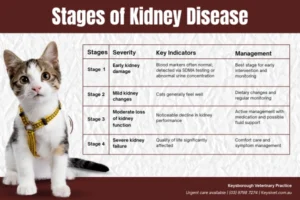
Once a diagnosis is confirmed, vets use the IRIS (International Renal Interest Society) staging system to classify the disease stage. This helps guide treatment decisions and gives you a clearer picture of where your cat is.
The stages of kidney disease in cats are:
- Stage 1: Kidney damage is present, but blood markers may still be within normal range. Stage 1 kidney disease is often only picked up through SDMA testing or abnormal urine concentration. This is the best time to catch it.
- Stage 2: Mild kidney changes. Many cats at this stage feel reasonably well and can be managed effectively with dietary changes and monitoring.
- Stage 3: Moderate loss of kidney function. More active management is needed, including medication and potentially fluid support.
- Stage 4: Severe kidney failure. Quality of life is significantly affected, and treatment focuses on comfort and managing symptoms.
The reassuring news: cats with Stage 1 or 2 CKD can often live well for years with the right management in place. The stage of the disease at diagnosis has a big impact on outcomes, which is why early detection and treatment matter so much.
Treatment Options for Cats with Kidney Disease
There’s no cure for chronic kidney failure, but there’s a lot that can be done to slow disease progression and keep your cat comfortable. Cats with CKD can live good-quality lives, sometimes for years after diagnosis, with the right support.
- Dietary changes
A kidney diet: low in phosphorus and high in moisture, is one of the most effective tools we have. Reducing phosphorus intake helps protect remaining kidney tissue. Wet food or a renal-specific prescription diet is usually recommended for cats with kidney disease.
- Hydration support
Keeping cats with CKD well-hydrated is really important. Options include:
- Encouraging wet food and water intake
- Subcutaneous fluids (given under the skin at home or at the clinic): many owners learn to do this themselves with guidance from their vet
- Intravenous fluids during hospital visits for more severe dehydration
- Medications
Depending on the stage of the disease and individual needs, medications may include:
- Blood pressure medication: to manage high blood pressure and protect the kidneys and eyes
- Phosphate binders: to reduce phosphorus absorption from food
- Anti-nausea medications: to improve appetite and reduce vomiting
- Appetite stimulants or gut-protection medications as needed
The treatment plan for cats with chronic kidney disease is tailored to the individual cat. What works well for one cat may not suit another, so ongoing monitoring is key.
Senior Cat Wellness Checks at Keysborough Veterinary Practice: Early Detection and Intervention for Cats Over the Age of 7
For cats over the age of 7, annual wellness checks that include blood and urine testing are strongly recommended. Cats over 10 years are at significantly higher risk, and for cats over 15, CKD affects more than half of the population.
Many cats with early-stage kidney disease look perfectly healthy on the outside. Routine screening is the only reliable way to catch it before significant kidney function is lost.
At Keysborough Veterinary Practice, we offer senior cat wellness checks that include in-house blood panels, blood pressure measurement, urine testing, and a full physical examination. Running these tests in-house means we can often have results ready on the same day, which means less waiting around for you.
Senior cats with kidney disease aren’t a lost cause. Early diagnosis and treatment give your cat the best possible shot at a long, comfortable life.
If you’re concerned about your cat’s health or they’re due for a senior wellness check, get in touch with the team at Keysborough Veterinary Practice in Keysborough. We’re here to help.
Book a senior wellness check for your cat today: call KeysVet or book online.
Frequently Asked Questions
What are the first signs of kidney disease in cats?
The most common early signs are drinking more water, urinating more often, and gradual weight loss. Many cats also seem quieter or less interested in food. Because these signs can be easy to miss, annual blood and urine testing is the most reliable way to catch kidney disease early.
Can cats live a normal life with CKD?
Many cats with Stage 1 or 2 CKD do very well for years with the right diet, hydration, and monitoring. Quality of life for cats with well-managed kidney disease can remain excellent: the key is catching it early and staying on top of regular check-ups.
What causes kidney disease in cats?
There’s rarely one single cause. Age is the biggest risk factor, but genetics, diet, infections, kidney stones, high blood pressure, and certain medications or toxins can all contribute. In many cases, no specific cause is ever identified.
Is kidney disease in cats painful?
CKD itself isn’t typically painful, but the symptoms: nausea, fatigue, poor appetite, can make cats feel quite unwell. With proper management, most cats remain comfortable for a long time after diagnosis.
How often should senior cats have kidney screening?
For cats aged 7 and over, we recommend annual blood and urine testing. Cats with an existing diagnosis or elevated risk factors may need more frequent monitoring: your vet will advise on the right schedule for your cat.
