



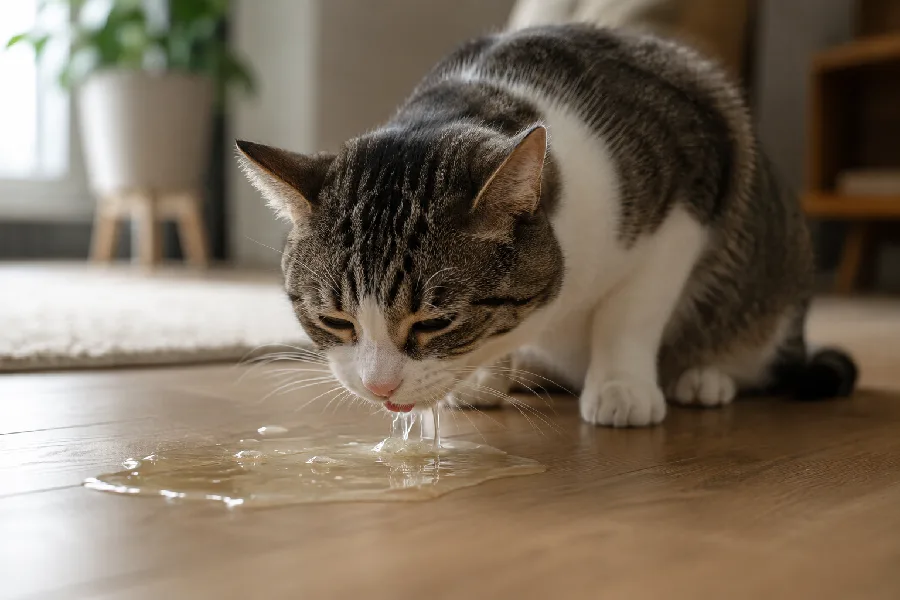
If you have ever walked into a room and found your cat throwing up a small puddle of clear liquid, you know that slightly panicked feeling that follows. Is it serious? Should you call the vet right now, or just keep an eye on things?
The honest answer is: it depends. A cat vomiting clear liquid once is not automatically a crisis. But if it keeps happening, or if other symptoms show up alongside it, that is a different story entirely. Understanding what different types of cat vomit look like and what they mean can help you make a much better call about when to act.
According to Animal Medicines Australia, cats are now found in 34% of Australian households, which means millions of Melbourne cat owners are navigating this exact question regularly. Gastrointestinal disease is the number one health ailment requiring vet visits in cats across Australia, so knowing your way around the topic is genuinely useful.
Common Causes of Cat Vomiting: Why Do Cats Vomit?
Before getting into what vomiting clear liquid means specifically, it helps to understand feline vomiting causes more broadly.
Cats vomit for a surprisingly wide range of reasons. Some are totally benign. Others are signs that something is going wrong inside the digestive tract. Here are the most common causes of cat vomiting:
- Eating too quickly: A cat that bolts its cat food can trigger vomiting almost immediately after a meal. The stomach fills too fast and simply pushes the contents back up. Undigested food, or food that is only partially digested, often comes up in a tubular shape.
- Hairballs: Cats groom constantly, and that means they ingest a lot of fur. When hair accumulates in the cat’s stomach, the body tries to expel it. Vomiting hairballs is a normal part of cat’s life, but frequent vomiting of hairballs is not something to ignore.
- An empty stomach: When a cat goes too long without eating, stomach acid and bile can build up and irritate the stomach lining, leading the cat to vomit on an empty stomach. This often produces a clear or yellowish liquid.
- Dietary changes: A sudden switch in cat food can upset the digestive system. Cats do not adapt quickly to new foods, so any change should be made gradually.
- Inflammatory bowel disease (IBD): This is a chronic condition where the digestive tract becomes persistently inflamed. Cats with IBD may vomit frequently and lose weight over time.
- Kidney disease: Kidney disease is one of the more common serious conditions in older cats. It can cause nausea and frequent vomiting as toxins build up in the bloodstream.
- Ingesting a foreign object: A cat that has swallowed something it should not have, a piece of string, a small toy, or any other foreign object, can develop an intestinal blockage. This is a serious situation.
- Intestinal parasites: Worms and other parasites can irritate the digestive tract and trigger vomiting in cats of all ages.
- Hyperthyroidism and other systemic illnesses: Overactive thyroid glands and various other conditions affecting the whole body can also trigger vomiting.
Cat Vomit Colour Guide: What Vomit Looks Like and What It Means
One of the most useful things you can do when your cat vomits is take a close look at what came up. Cat vomit colour gives you real information about what might be going on.
| Vomit Appearance | What It Usually Indicates |
| Clear liquid or water | Stomach fluid, saliva, drinking too fast, or an empty stomach |
| White foam | Stomach irritation or regurgitation from the oesophagus |
| Yellow or bile-coloured | Vomiting on an empty stomach; bile from the digestive tract |
| Throwing up yellow liquid | Bile buildup; consider more frequent meals |
| Undigested or partially digested food | Eating too quickly or having a food intolerance |
| Vomiting hairballs | Normal hair ingestion from grooming, but frequent vomiting of hairballs warrants attention |
| Green vomit | Contents from the small intestine; worth a vet check |
| Vomiting blood or vomit that looks like coffee grounds | Urgent, requires immediate veterinary attention |
| Black liquid | Digested blood is lower in the intestinal tract; vet immediately |
Cat Vomiting Clear Liquid: What Does It Mean?
So your cat is vomiting clear liquid specifically. Here is what that usually tells you.
Clear liquid vomit typically means the cat is throwing up water, saliva, or the fluid contents of the stomach. This can occur due to drinking too fast, stomach irritation, or nausea from something the cat has eaten.
A few specific scenarios to be aware of:
- Vomiting on an empty stomach: If your cat vomits first thing in the morning before eating, this is often related to stomach acid accumulation overnight. Offering a small meal before bed or splitting meals into more frequent meals throughout the day can help.
- White foam: When clear vomit has a foamy texture, it is usually regurgitation from the oesophagus or stomach. White foam in cat vomit is a sign that the internal lining of the stomach is likely inflamed.
- Clear liquid several times in a row: If your cat is vomiting clear liquid repeatedly in a short period, do not wait to see if it resolves on its own. That is when you need to call your veterinarian.
One important distinction is that cats will vomit and cats will also regurgitate, and the two are not the same thing. Vomiting involves visible effort, abdominal contractions, and often some warning signs like retching. Regurgitation is much more passive and tends to happen almost without warning, usually very soon after eating. If you are unsure which one your cat is doing, try to film it on your phone; it is genuinely helpful information for your vet.
Vomiting in Cats on an Empty Stomach: The Bile Issue
Cats with mild cases of vomiting on an empty stomach may vomit yellow liquid or a foamy liquid rather than purely clear fluid. A yellowish shade in cat vomit often indicates bile, a digestive fluid from the liver. This can happen when a cat’s stomach is empty for too long.
If your cat vomits yellow regularly in the early morning, the simplest fix is to try offering a small meal later at night so the stomach is not empty by morning. If it continues, that is a conversation to have with your veterinarian.
Is Your Cat Throwing Up Clear Liquid? When to Call Your Vet
Not every episode of vomiting requires a trip to the vet. But there are clear signs that require veterinary attention sooner rather than later. Frequent vomiting is never normal, even in cats that have a history of sensitive stomachs, and it should never be dismissed as “just what they do.”
Contact your vet as soon as possible if your cat is showing:
- Vomiting more than two or three times in 24 hours
- Vomiting blood or vomit that looks like coffee grounds
- Signs of an intestinal blockage (your cat may require surgery if a foreign object is involved)
- Lethargy, loss of appetite, or significant behaviour changes
- Diarrhoea alongside the vomiting
- Signs of dehydration, such as dry gums, sunken eyes, or skin that does not spring back when gently pinched
- Persistent vomiting over several days
- Acute vomiting that comes on suddenly and does not stop
Go to the vet immediately if your cat is:
- Vomiting blood
- In obvious distress or pain
- Showing signs of an intestinal blockage, your cat may require surgery
- Unresponsive or extremely lethargic
At Keysborough Veterinary Practice, the team provides urgent care for cats experiencing persistent vomiting, as well as general pathology, X-rays and ultrasounds to investigate what is going on internally.
How Vets Diagnose and Treat Cat Vomiting?
When you bring your cat in for vomiting, the veterinarian will start by taking a thorough history. How often is the cat vomiting? What does the vomit look like? Has the cat food or routine changed recently? What has the cat had access to?
From there, depending on what the vet finds on examination, diagnostics may include:
- Blood and urine tests to check for kidney disease, hyperthyroidism, inflammatory bowel disease, and other systemic conditions
- Faecal testing to rule out intestinal parasites
- X-rays or ultrasound to look for a foreign object, intestinal blockage, or any abnormalities in the digestive tract
- Endoscopy or biopsy in cases where inflammatory bowel disease or cancer is suspected
Cats with mild cases of vomiting can often be treated on an outpatient basis with fluids, supportive care, and a bland diet. Some form of fluid therapy is given for almost every cause of vomiting. Cats that are more unwell, or significantly dehydrated, may require fluid therapy and supportive care in a hospital.
Tips to Help Reduce Cat Vomiting at Home
If your cat’s vomiting is from indigestion or eating habits rather than an underlying illness, these practical steps can help:
- Use a slow-feeder bowl, so your cat cannot eat too quickly
- Offer frequent meals in smaller portions rather than one large serving, so your cat cannot eat too much at once
- Groom your cat regularly to reduce the amount of fur they ingest, particularly for long-haired cats prone to vomiting hairballs
- Switch cat food gradually over seven to ten days rather than all at once
- Keep your cat away from string, ribbon, small toys, and plants that could be swallowed
- Try dry cat food alternatives if wet food is causing issues, or vice versa
What Australian Cat Owners Should Know
According to PetSure claims data, in 2024, gastroenteritis was the most claimed condition in cats across Australia. Gastrointestinal issues are the primary problem for cats across all age groups in Australia, and 69% of cat owners reported taking their cat to the vet in the last year.
Many cats experiencing mild digestive upset will recover with simple care at home. But many cats also have underlying conditions that go undiagnosed for longer than they should, simply because owners assume vomiting is normal. In Melbourne, particularly, where we have a large population of indoor cats, factors such as stress, diet, and limited exercise can contribute to chronic digestive issues.
If your cat has vomited more than twice in a short period, or if you notice any blood, significant lethargy, or signs of pain, that is the time to contact a Melbourne veterinarian rather than waiting to see what happens.
If you are a new cat owner, it is also worth reading up on cat vaccinations in Australia and kidney disease in cats, as both topics are closely connected to vomiting as a symptom. You might also find it helpful to review the Keysborough Vet guide on cat urinary blockages, another condition that can cause a cat to vomit or stop eating.
Frequently Asked Questions
1. Why is my cat vomiting clear fluid?
Clear vomit is usually stomach fluid, saliva, or water. It can happen when a cat has an empty stomach, drinks too quickly, or has mild stomach irritation. If it happens repeatedly, see your vet.
2. Is it normal for cats to vomit clear liquid?
Occasional vomiting can occur in healthy cats, but frequent vomiting is never normal for a cat. If your cat is vomiting clear liquid several times a week or more, it needs a vet assessment.
3. What does white foam in cat vomit mean?
White foam typically indicates stomach or oesophageal irritation. It is a form of regurgitation and, if occurring regularly, warrants a veterinary check.
4. When should I take my cat to the vet for vomiting?
Take your cat to the vet as soon as possible if it vomits more than two or three times in 24 hours, if there is blood in the vomit, or if your cat seems lethargic, is not eating, or has diarrhoea alongside the vomiting.
5. Can kidney disease cause a cat to vomit?
Yes. Kidney disease is one of the more common causes of persistent vomiting in older cats. A veterinarian can diagnose this through blood and urine testing.
