



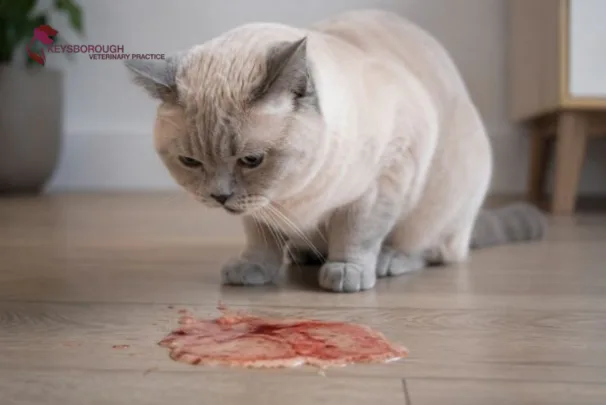
If your cat is vomiting blood, call a veterinary clinic now for triage. Fresh blood may look red or streaked through vomit. Digested blood can look dark brown or black, sometimes compared with coffee grounds. Either appearance deserves prompt veterinary advice because the source and severity cannot be judged reliably at home.
If your cat is weak, collapsed, struggling to breathe, has pale gums, a painful or swollen abdomen, repeated vomiting, a possible toxin exposure or more than a small streak of blood, seek emergency veterinary care immediately. During opening hours, call Keysborough Veterinary Practice on (03) 9798 7274 before travelling. The clinic is not staffed overnight, so a critically unwell cat after hours needs an open 24-hour veterinary hospital.
This article explains what blood in cat vomit can mean, what information to collect and what a vet may need to check. It cannot diagnose your cat.
What can blood in cat vomit look like?
Veterinarians use the term haematemesis for vomiting blood. The appearance can vary:
- bright red streaks or spots
- red fluid mixed with food or mucus
- small clots
- dark brown or black granular material
- vomit that resembles wet coffee grounds
Bright red blood may be relatively fresh. Dark material can indicate blood that has been exposed to stomach acid. Colour alone cannot identify the cause or tell you that the problem is minor.
Take a clear photograph before cleaning the area. If practical and safe, a small sample in a sealed container may help the veterinary team. Note the time, number of episodes and whether the material contained food, hair, plants, string or another object.
Do not delay care while trying to obtain a perfect sample. Your cat’s condition matters more than the photograph.
Is it definitely vomited blood?
Not every red or dark mark has come from the stomach. A cat may swallow blood from the mouth or nose and later vomit it. Red food or foreign material can also change the appearance.
Try to observe what happened immediately beforehand. Vomiting commonly involves nausea, abdominal contractions and retching. Regurgitation tends to be more passive and may bring up undigested food. Coughing involves the airway and can sometimes end with gagging or fluid.
Do not put your fingers into an alert cat’s mouth to search for an injury or object. A frightened or painful cat can bite, and pulling a visible string can cause internal injury. Tell the clinic what you saw and let the veterinary team examine the mouth safely.
Why might a cat vomit blood?
Blood can enter vomit for several reasons. Some are local to the mouth, oesophagus or stomach. Others involve disease elsewhere in the body. A veterinary examination and, in some cases, diagnostic tests are needed to separate them.
Irritation after repeated vomiting
Forceful or repeated vomiting can irritate tissue in the upper digestive tract and produce a small amount of fresh blood. Even if the blood appeared only after several episodes, the reason for the original vomiting still needs attention.
Repeated vomiting can also lead to dehydration and electrolyte changes. A cat that cannot keep water down, becomes quiet or continues to retch should not be monitored indefinitely at home.
Mouth, dental or nasal bleeding
Blood from an oral injury, dental disease or nosebleed may be swallowed. The cat can then vomit material containing blood, even though the initial source is not the stomach.
Look without forcing the mouth open for obvious external facial injury or active nasal bleeding. Do not attempt a detailed oral examination yourself.
Inflammation or ulceration
Inflammation or ulceration in the oesophagus or stomach can bleed. Veterinary references note that gastrointestinal ulceration may also be associated with reduced appetite, abdominal pain, vomiting and weight loss, although signs can be nonspecific.
Ulceration is not something an owner can confirm from colour. Other conditions can produce a similar appearance, so treatment should follow diagnosis rather than assumptions.
A swallowed object
String, ribbon, thread, bones, toys and other objects can irritate, obstruct or damage the digestive tract. Cats may hide the initial event, and an owner may only notice vomiting, reduced appetite or discomfort.
Visible string from the mouth or anus should not be pulled. Contact a vet promptly. An obstruction can become serious and may require imaging or surgery.
Toxins or unsuitable medicines
Some toxins can cause irritation, organ injury or abnormal bleeding. Human medicines can also be dangerous to cats, including products that owners may consider ordinary pain relief.
If exposure is possible, bring the package or photograph the label. Record the amount, time and route if known. Do not induce vomiting or give food, milk, oil, charcoal or medication unless a veterinarian specifically instructs you.
A problem with blood clotting
Bleeding can occur when clotting is impaired. Possible contexts include certain toxins, severe illness, liver problems, low platelets or other disorders. You may also notice bruising, nosebleeds, pale gums or bleeding elsewhere, but the absence of these signs does not rule the problem out.
Suspected abnormal bleeding needs urgent assessment because the visible vomit may represent only part of the problem.
Disease affecting other organs
Kidney, liver, pancreatic, inflammatory, infectious and other systemic diseases can be associated with vomiting. Some may also contribute to irritation or bleeding. Older cats and cats with known illnesses may have less reserve when vomiting begins.
The list of possibilities is broad, which is why internet symptom matching is unsafe here. The vet uses the history, examination and tests to narrow it.
Masses or other gastrointestinal disease
Growths and other diseases within the digestive tract can cause vomiting, reduced appetite, weight loss or bleeding. These are not the only explanations and should not be assumed from one episode, but persistent or recurrent signs need investigation.
When is cat vomiting blood an emergency?
Treat the situation as an emergency if your cat has any of the following:
- collapse, marked weakness or inability to stand
- pale, white, grey or blue-tinged gums
- difficulty breathing or open-mouth breathing
- Repeated vomiting or inability to keep water down
- a large amount of blood or ongoing bleeding
- dark, tar-like stool
- a swollen, tense or painful abdomen
- suspected poisoning or access to human medicine
- possible string, ribbon, bone or foreign-object ingestion
- recent trauma
- severe pain, distress or unusual unresponsiveness
- a kitten, an elderly cat or a cat with a significant existing illness that is deteriorating
If you are unsure, call. Veterinary staff can ask triage questions and direct you to the appropriate level of care. Keysi Vet provides urgent pet care during published opening hours and advises owners to phone before arriving.
What should you do before leaving for the vet?
Keep the steps simple and safe.
- Call the clinic and describe the blood, vomiting frequency and your cat’s current behaviour.
- Follow the veterinary team’s transport and first-aid instructions.
- Keep your cat quiet and place them in a secure carrier with a towel.
- Bring photographs or a sample if easily available.
- Bring medicine, toxin or plant packaging if exposure is possible.
- List current medicines and known health conditions.
- Note the last time your cat ate, drank, urinated and passed stool.
Do not force food or water into a nauseated cat. Do not give human medicine. Do not attempt to make the cat vomit. Do not pull a string or another object from the mouth.
What information will the vet need?
The history helps direct the examination. Be ready to explain:
- When vomiting began
- How many episodes occurred
- whether blood appeared in the first episode or after repeated retching
- the colour and approximate amount
- appetite and water intake
- urine and stool changes
- recent weight loss or previous vomiting
- access to bins, plants, string, toys, chemicals or medicines
- current prescriptions and supplements
- recent injuries, procedures or travel
- existing kidney, liver, digestive or clotting conditions
Do not worry if you cannot answer everything. A short video of the event can be useful if it can be taken without delaying care or distressing the cat.
How might a vet investigate blood in a cat’s vomit?
The veterinary team first assesses stability. This may include gum colour, heart and breathing rate, hydration, temperature, pain and abdominal findings. A severely unwell cat may need stabilisation while the cause is investigated.
Depending on the history and examination, recommendations may include:
- blood tests to assess red cells, platelets, organ function and other changes
- urine testing
- clotting tests
- X-rays to look for some foreign objects, obstruction patterns or other abnormalities
- ultrasound to examine abdominal organs and the digestive tract
- further imaging, endoscopy, referral or surgery where indicated
Not every cat needs every test. Keysi Vet’s veterinary pathology facilities include in-house urgent bloodwork, and its urgent-care facilities include X-ray and FAST ultrasound capability. The veterinarian will recommend tests based on your cat’s condition.
How is vomiting blood treated?
Treatment depends on the cause and severity. It may involve fluid support, medicines to control nausea, gastrointestinal protection, treatment of toxin exposure, management of an underlying disease or removal of a foreign object. A cat with significant blood loss or clotting problems may require more intensive care.
There is no single home remedy for haematemesis. Products that appear to settle a stomach may be unsuitable for cats or may delay treatment. Follow the treating veterinarian’s instructions, including feeding, medication, and recheck advice.
Could a hairball cause a small streak of blood?
Repeated retching around a hairball may irritate tissue and be followed by a small streak, but owners should not assume a hairball explains blood. The cat may be vomiting for another reason, and coughing is often mistaken for hairball retching.
Blood, repeated unproductive retching, poor appetite, lethargy or ongoing vomiting warrants veterinary advice. A blockage from accumulated hair is uncommon but can be serious.
How can future episodes be reduced?
Prevention depends on the diagnosis. General steps include keeping medicines and toxic products inaccessible, removing loose strings and ribbon, using secure bins and following veterinary advice for any chronic condition.
Regular grooming may reduce swallowed loose hair in cats prone to hairballs. It will not prevent vomiting caused by disease, toxins or foreign objects.
Keep a record if vomiting recurs. Dates, photographs, food changes, appetite and weight can help a veterinarian see a pattern that is difficult to reconstruct later.
Call a vet if you see blood in your cat’s vomit
Blood in vomit is not a symptom to diagnose from a photograph alone. Call for triage even if your cat currently appears comfortable, and seek immediate care when any emergency warning sign is present.
Keysborough Veterinary Practice is an independent clinic at 4-8 Chapel Rd, Keysborough and has served the area since 1988. During opening hours, call (03) 9798 7274 before travelling for an urgent case. If the clinic is closed and your cat is critically unwell, contact an open 24-hour veterinary hospital.
Frequently asked questions
Is a tiny streak of blood in a cat’s vomit an emergency?
It still needs prompt veterinary advice. A small streak can follow irritation, but the appearance does not identify the cause. Seek immediate care if vomiting repeats, your cat is weak or painful, gums are pale, a toxin or foreign object is possible, or more blood appears.
What does digested blood in a cat’s vomit look like?
It may appear dark brown or black and granular, sometimes described as resembling coffee grounds. Food and other material can look similar, so take a photograph and let a veterinarian assess the full situation.
Should I feed my cat after they vomit blood?
Call a veterinary clinic first and follow its instructions. Do not force food or water, and do not give human medicine. Feeding advice depends on your cat’s condition and the suspected cause.
Can I wait until morning if my cat seems normal?
Do not make that decision without veterinary triage. Call an open clinic or emergency hospital, describe what you saw and follow its advice. Blood plus repeated vomiting, weakness, pale gums, pain, breathing difficulty or suspected toxin exposure requires immediate care.
